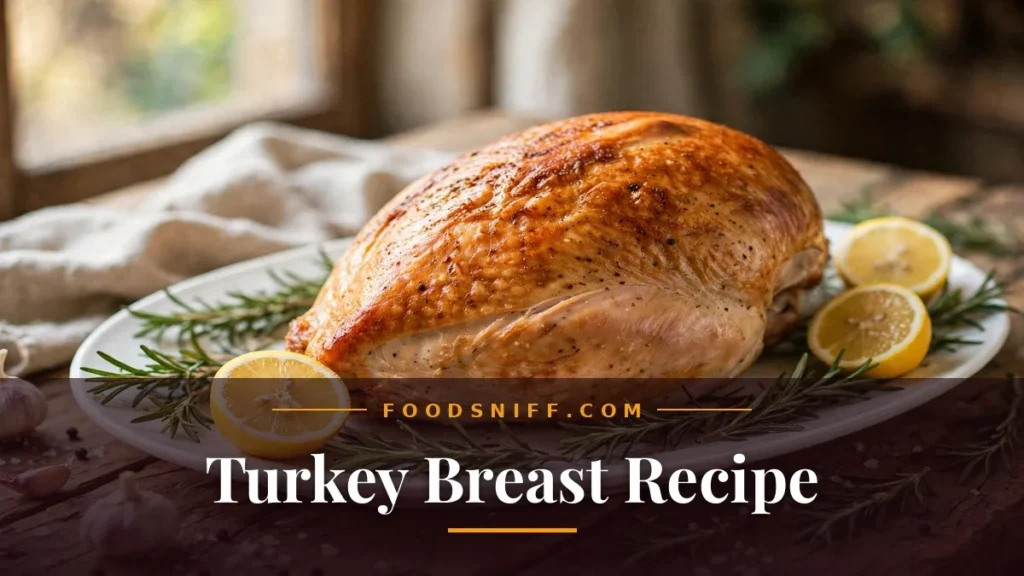
Roasted turkey breast is a bone-in breast rubbed with herb butter and roasted until the skin turns crisp and golden. This version starts hot at 425 degrees, finishes at 350, and pulls at 160 so it rests up to 165. It takes 15 minutes to prep and under two hours in the oven, and it feeds eight.
A whole turkey feeds a crowd, but it also takes all day and leaves a fridge full of leftovers. A single breast solves both problems. It roasts in under two hours, it feeds eight, and the slices come out just as golden as a whole bird.
The method below is the one the top recipes agree on, with the gaps filled in. A hot start crisps the skin, a lower finish cooks the meat through, and a thermometer decides when it comes out. The rest is butter, herbs, and a little patience.
What is a turkey breast roast?
A turkey breast roast is a bone-in breast, usually 5 to 7 pounds, roasted whole with the skin on. It is the white meat of the bird without the legs, wings, and carcass, so it cooks faster and carves in minutes.
It suits a Thanksgiving table for six to eight, a Christmas dinner, or any Sunday when a whole bird is too much. The slices work the same way the next day, cold in sandwiches or warmed in gravy.
Bone-in or boneless, skin-on or skinless
The cut you buy decides the cooking time, the flavor, and how the slices look. Bone-in stays juicier because the bone slows the heat and keeps the meat from drying out. Boneless cooks faster and slices into neat rounds, but it dries out sooner if you look away.
Which one to buy
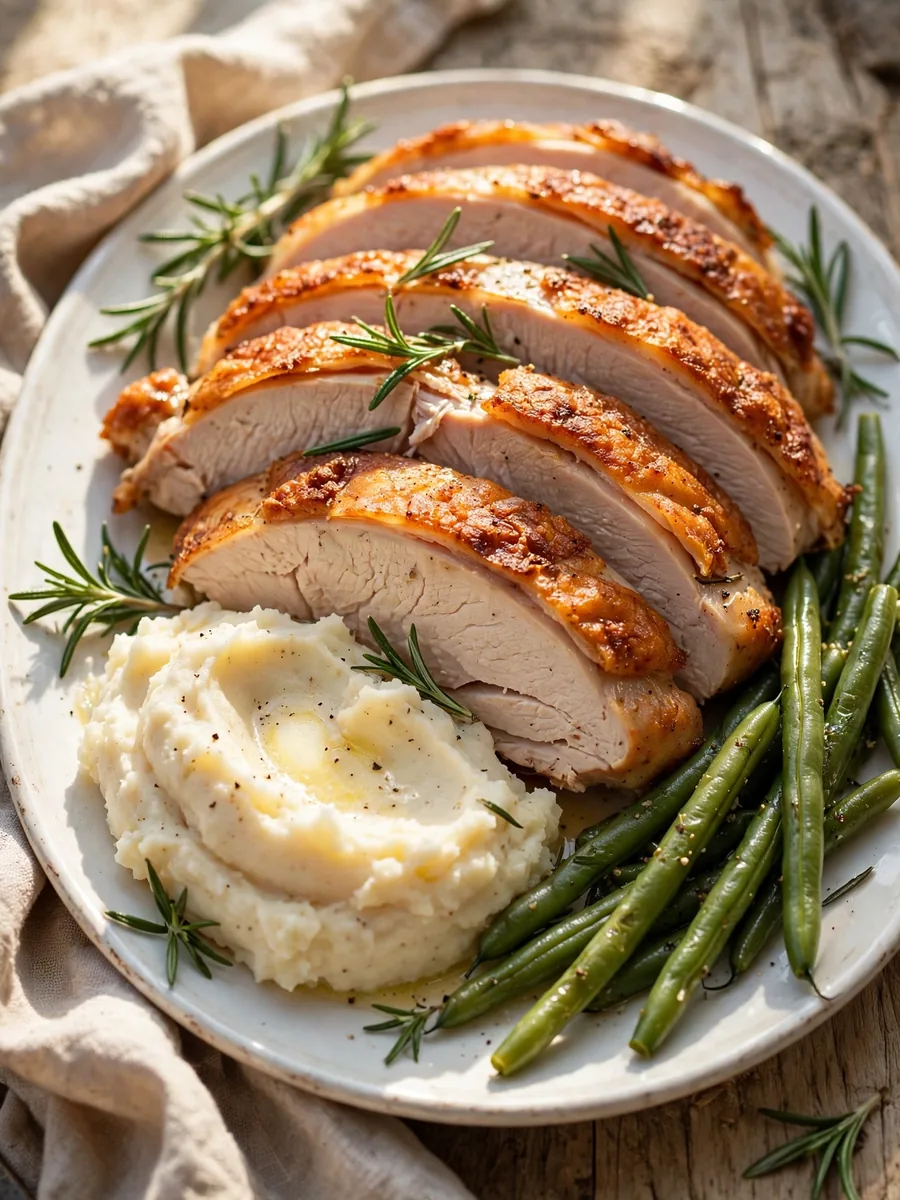
Buy bone-in, skin-on for a holiday table. The bone protects the meat, the skin turns crisp and golden, and the roast looks like a centerpiece when it comes out of the oven. Most stores sell it as a whole breast, sometimes labeled a hotel breast, and a 6 pound one feeds eight.
Buy boneless, skin-on when you want speed and easy slicing. A 4 to 5 pound boneless breast roasts in about an hour, and it carves into even slices with no bone to work around. Skip boneless skinless unless you plan to cook it low and slow, since the bare meat dries out fast.
How much turkey breast per person
Plan on 3/4 pound per person for a bone-in breast and 1/2 pound per person for boneless. The bone and skin make up about a quarter of the weight, so a 6 pound bone-in breast gives about 4 1/2 pounds of meat. Buy a pound more per person if you want leftovers.
A 3 pound breast feeds four, a 6 pound breast feeds eight, and an 8 pound breast feeds ten to twelve. Two small breasts beat one huge one when the crowd grows, since they roast faster and more evenly than a single 10 pound breast.
Turkey breast ingredients
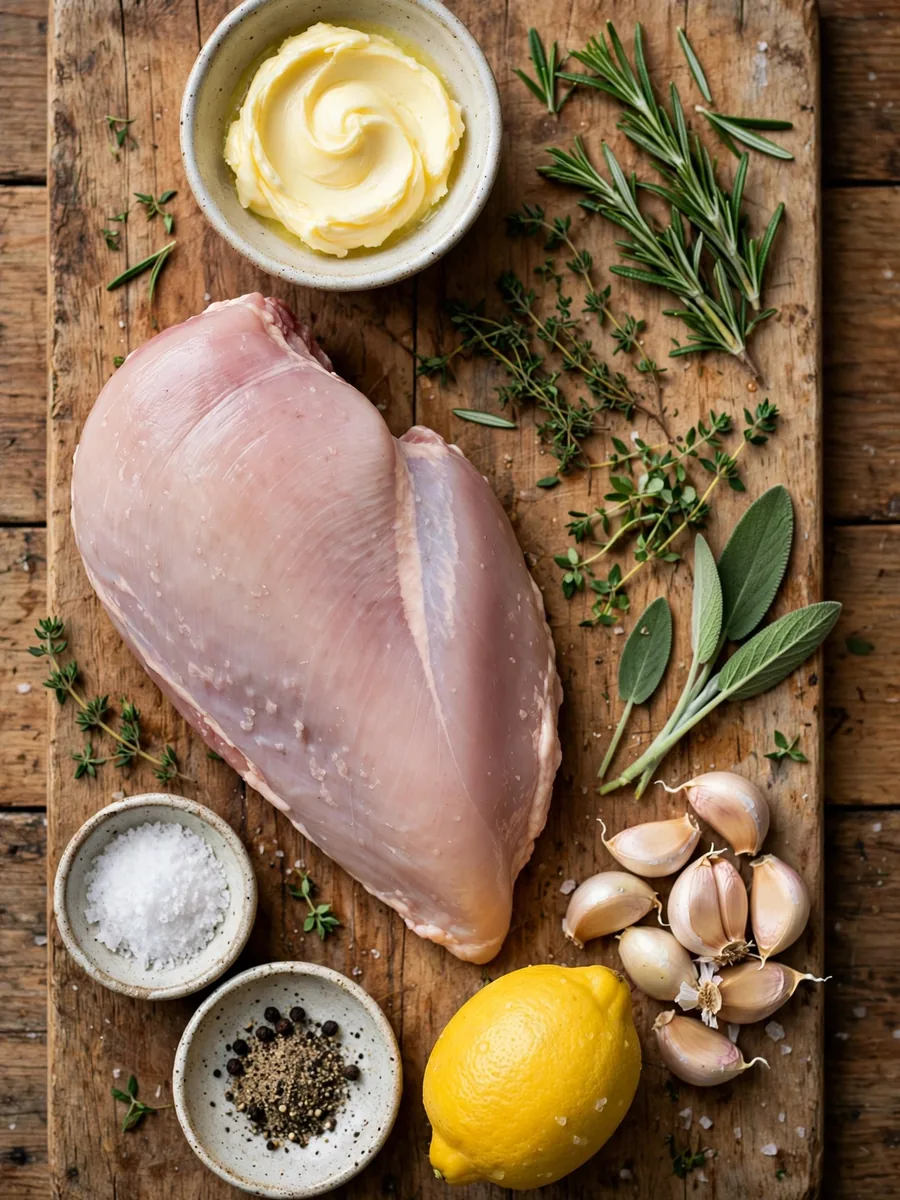
The list is short: a breast, butter, herbs, and a lemon. Everything else is pantry seasoning. The butter does most of the work, carrying flavor into the meat and crisping the skin.
The herb butter
Softened butter mixes with garlic, rosemary, thyme, sage, lemon zest, salt, and pepper into a spread. Half goes under the skin, where it melts straight into the meat, and the rest goes on the outside, where it browns the skin.
Use unsalted butter so you control the salt, especially if the breast was brined. Dried herbs work in a pinch, one teaspoon of each in place of a tablespoon fresh, but fresh rosemary and thyme give the stronger flavor.
To brine or not to brine
Brining is optional for this recipe, and the herb butter covers most of what a brine would do. A wet brine needs a full day in the fridge and a pot big enough to hold the breast, which is more work than most cooks want for a weeknight roast.
A dry brine is the easier middle ground. Rub 1 tablespoon of kosher salt over the breast, set it uncovered on a rack in the fridge, and leave it 12 to 24 hours. The salt seasons the meat all the way through and dries the skin, which crisps better in the oven.
If you dry brine, skip the salt in the herb butter and season with pepper only. If you skip brining entirely, pat the breast very dry before the butter goes on, since dry skin is what turns crisp and golden.
How to cook turkey breast in the oven
The method has four moves: dry, butter, roast, rest. The oven does the long work in the middle, and the thermometer tells you when it is done. Start the oven hot, then turn it down.
Prep the breast
Thaw a frozen breast in the fridge, about 24 hours for every 4 to 5 pounds, so a 6 pound breast needs about a day and a half. Take it out of the fridge an hour before cooking so it roasts evenly instead of starting ice cold.
Set the oven rack low and heat the oven to 425 degrees. Pat the breast dry with paper towels, inside and out, then set it skin side up on a rack in a roasting pan. Pour a cup of water or low sodium chicken broth into the pan, which keeps the meat moist and becomes gravy later.
Butter under the skin
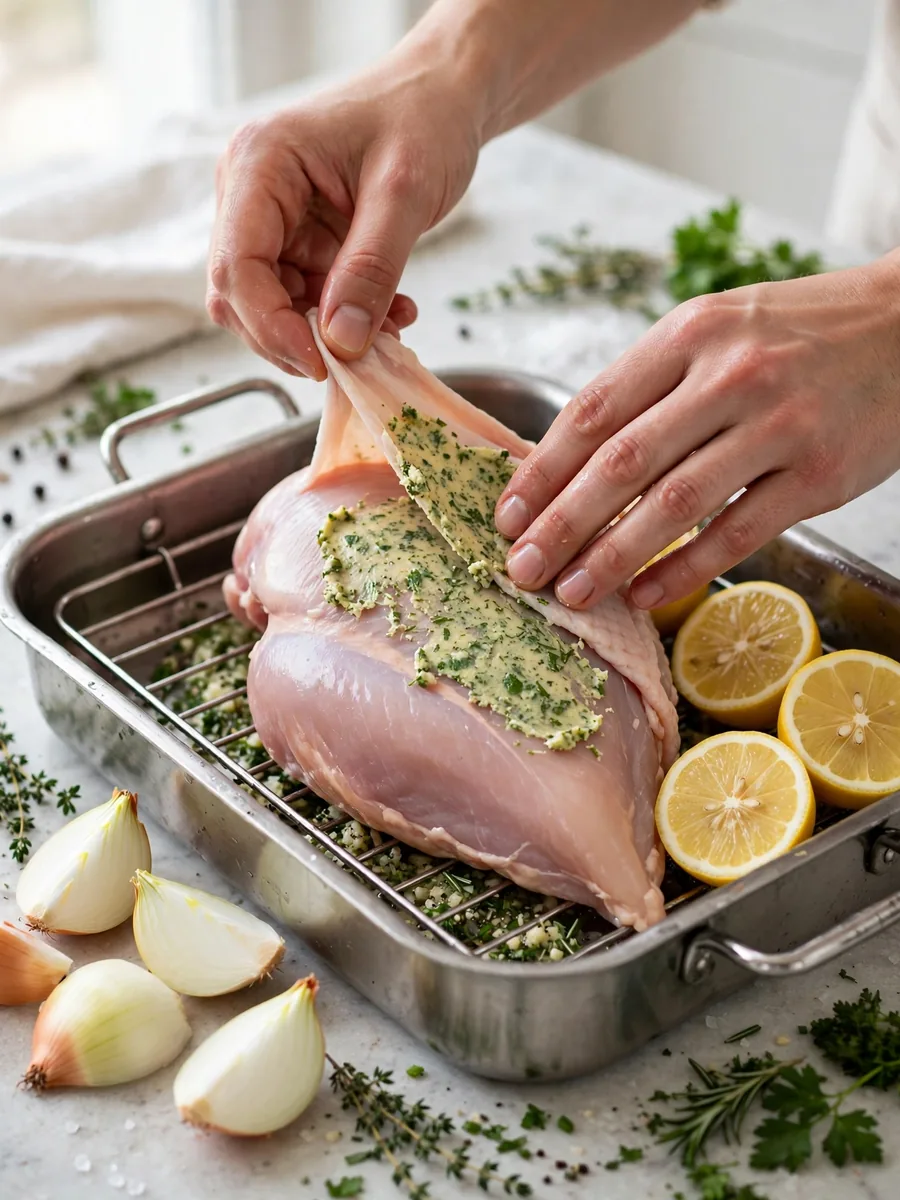
Slide your fingers gently under the skin to loosen it from the meat, working from the neck end toward the center. Do not tear it, since torn skin shrinks back and leaves bare meat that dries out.
Spread half the herb butter under the skin with your hands, pushing it as far across the breast as it will go. Rub the rest over the outside, then tuck the lemon halves and onion quarters into the pan around the breast.
Which oven temperature
Every top recipe picks a different temperature, and all of them work, because the thermometer decides the finish. At 325 degrees the meat stays a little juicier, but the skin browns slowly and a 6 pound breast takes over two hours. At 375 the skin crisps fast, but the outside can overcook before the center catches up.
The hot start splits the difference. Twenty minutes at 425 degrees sets the skin, then 350 degrees finishes the meat gently. It is the fastest route to crisp skin and juicy meat in one roast, which is why this recipe uses it.
Roast to temperature, not time
Roast at 425 degrees for 20 minutes, until the skin starts to color. Turn the oven down to 350 degrees and keep roasting, about 14 to 16 minutes per pound from here, until a thermometer in the thickest part reads 160 degrees.
Time is only a guide, since ovens run hot or cold and breasts vary in shape. Start checking 15 minutes before the time is up, and check in two spots, since the thickest part near the bone lags behind the thinner edges.
| Cut | Oven | Minutes per pound | 6 pound total |
|---|---|---|---|
| Bone-in, skin-on | 425 then 350 | 14 to 16 after the hot start | About 1 hour 45 minutes |
| Bone-in, skin-on | 325 | About 20 | About 2 hours |
| Bone-in, skin-on | 375 then 325 | About 20 | About 2 hours |
| Boneless, skin-on | 350 | 15 to 20 | About 1 hour 15 minutes for a 4 to 5 pound breast |
| Boneless, skinless | 350 | 15 to 20 | About 1 hour for a 3 to 4 pound breast |
Rest before slicing
Take the breast out at 160 degrees, tent it loosely with foil, and rest it 15 minutes. The temperature climbs to 165 degrees while it rests, which is the safe temperature for turkey, and the juices settle back into the meat.
Cutting it hot sends the juices onto the board instead of into the slices. Fifteen minutes is the minimum, and twenty is better when the breast is large, since a bigger roast holds its heat longer.
Make a quick gravy while it rests
While the breast rests, set the roasting pan over medium heat on the stove. Pour in a cup of chicken broth and scrape up the browned bits from the bottom, then whisk in a tablespoon of cornstarch mixed with cold water.
Simmer two or three minutes until it thickens enough to coat a spoon. Season with salt and pepper, and pour it over the slices at the table. The water in the pan gives you more drippings to work with.
Turkey breast recipe
This is the classic version: a 6 pound bone-in breast, herb butter under the skin, a hot start, and a slow finish. It feeds eight, it takes about two hours from oven to table, and the pan drippings make gravy.
Prep time: 15 minutes
Cook time: 1 hour 45 minutes
Serves: 8
Ingredients
- 1 bone-in, skin-on turkey breast, about 6 pounds
- 6 tablespoons unsalted butter, softened
- 1 tablespoon olive oil
- 4 cloves garlic, minced
- 1 tablespoon chopped fresh rosemary
- 1 tablespoon chopped fresh thyme
- 1 teaspoon chopped fresh sage
- 1 teaspoon lemon zest
- 1 1/2 teaspoons kosher salt
- 1 teaspoon black pepper
- 1 lemon, halved
- 1 medium yellow onion, quartered
- 1 cup water or low-sodium chicken broth
Steps
- Heat the oven to 425 degrees. Set the rack low in the oven.
- Pat the turkey breast dry with paper towels. Set it skin side up on a rack in a roasting pan.
- Stir the butter, olive oil, garlic, rosemary, thyme, sage, lemon zest, salt, and pepper into a spread.
- Loosen the skin with your fingers. Spread half the butter under the skin and rub the rest over the outside.
- Tuck the lemon halves and onion quarters into the pan. Pour the water or broth into the bottom of the pan.
- Roast 20 minutes at 425 degrees, until the skin starts to color.
- Turn the oven down to 350 degrees. Roast about 1 hour 25 minutes more, until a thermometer in the thickest part reads 160 degrees.
- Tent loosely with foil and rest 15 minutes, until the temperature reaches 165 degrees.
- Carve the meat off the bone, slice against the grain, and serve with the pan juices.
One serving has about 502 calories. That number comes from adding up USDA FoodData Central values for the turkey, the butter, the olive oil, the garlic, the onion, the lemon, and the broth. It is an estimate, not a lab result, and it moves a little with the size of the breast and how much skin you eat.
The turkey is most of the total, about 3,204 calories of the whole batch. The butter adds about 609 calories across eight servings, so using half the butter saves roughly 38 calories per slice.
How to keep turkey breast juicy
Turkey breast dries out in five ways: the oven runs too hot, the breast cooks past done, the skin stays soft, the breast cooks unevenly, or it gets sliced too soon. Each one has a plain cause and a plain fix.
| Problem | Fix |
|---|---|
| Meat comes out dry | Pulled past 165, or sliced with no rest. Pull at 160, rest 15 minutes, use a thermometer |
| Skin is rubbery | Breast went in wet, or roasted covered. Pat dry, roast uncovered, hot start at 425 |
| Skin browns too fast | Oven runs hot, or breast sits too high. Tent loosely with foil, move the rack down |
| Breast cooks unevenly | Cold from the fridge, or thick end faces the back. Rest at room temperature 1 hour, rotate the pan halfway |
| Meat sticks to the pan | No rack, or pan was dry. Use a rack, add a cup of water or broth to the pan |
Why it dries out
Turkey breast is lean, so it has almost no fat to protect it. Every degree past 165 squeezes more moisture out, and a breast cooked by the clock alone almost always overshoots. A thermometer is the only reliable check.
Pull at 160 degrees and let the rest carry it to 165. The five degrees of carryover finish the cooking gently, while the juices settle instead of running out onto the board.
Why the skin goes rubbery
Rubbery skin comes from moisture. A wet breast steams instead of roasting, and a covered breast never dries out enough to crisp. Pat the skin dry, roast uncovered, and keep the oven hot for the first 20 minutes.
If the skin browns too fast, tent it loosely with foil and keep cooking. The foil slows the browning while the meat catches up, and the skin stays crisp once the foil comes off for the last stretch.
How to slice a turkey breast
Take the whole breast off the bone first. Run a sharp knife along each side of the breastbone, then lift the meat away in one piece. Slicing on the bone tears the meat and leaves ragged edges.
Slice across the grain in even pieces about half an inch thick. Thin slices dry out fast on the plate, and thick slices are hard to chew, so half an inch is the middle ground. Pour a spoonful of pan juices over the slices before serving.
Keep the breast whole until serving time. A sliced breast loses moisture fast, while a whole breast holds its juices for an hour under loose foil. Slice only what the table needs, and carve the rest as seconds come up.
What to serve with turkey breast
The breast is the star, so the sides should stay simple. Mashed potatoes and green beans make it a Sunday dinner, while a slaw and baked beans make it a cookout plate. For the holiday table, add Thanksgiving sides like stuffing, cranberry sauce, and roasted vegetables.
Round out the meal with Thanksgiving casseroles such as sweet potato casserole or green bean casserole, which bake while the breast rests. The pan drippings make a quick gravy in ten minutes, so save them.
More turkey for the table
If you are cooking a whole bird for the holiday table instead, this turkey injection keeps the breast from drying out in the oven. For a different roast poultry dinner on another night, try these roasted poultry hindquarters, or set up slow cooker poultry in the morning and come home to dinner.
For a smaller holiday table that still wants turkey, this turkey meatloaf recipe feeds eight with less work and no carving. It uses the same 93 percent lean turkey and the same pull-at-160 rule.
Storage, leftovers, and freezing
Leftovers keep in the fridge for 3 to 4 days in a sealed container. Let the slices cool fully before the lid goes on, or trapped steam softens the skin overnight.
Reheating leftovers
Reheat slices in the oven at 325 degrees for 10 to 12 minutes, covered loosely with foil and with a spoonful of broth or gravy over them. The microwave works in a pinch, but it dries the edges, so heat in 30 second bursts and stop as soon as the slices are warm.
Freezing
Cooked slices freeze well for up to 2 months. Lay them flat in a freezer bag with the air pressed out, and label the bag with the date. Thaw overnight in the fridge before reheating.
Freeze the breast whole if you can, since whole meat holds moisture better than slices. Wrap it tightly in plastic wrap and foil, and thaw it in the fridge for a full day before reheating it low and slow.
Leftover ideas
Leftover turkey breast is the easiest part of the week. Slice it cold for sandwiches with cranberry sauce, dice it into a pot pie or a turkey salad, or shred it into soup and tacos. The meat stays good for days, so one roast covers three or four meals.
Scaling the recipe
The recipe scales cleanly in both directions. Keep the butter and seasoning in the same ratio to the meat, and go by temperature rather than time, since a bigger breast needs more minutes per pound to reach the center.
| Breast | Butter | Cook time at 425 then 350 | Servings |
|---|---|---|---|
| 3 pound bone-in | 3 tablespoons | About 1 hour | 4 |
| 4 pound bone-in | 4 tablespoons | About 1 hour 15 minutes | 6 |
| 6 pound bone-in | 6 tablespoons | About 1 hour 45 minutes | 8 |
| 8 pound bone-in | 8 tablespoons | About 2 hours 15 minutes | 10 to 12 |
Frequently asked questions
What temperature should turkey breast be cooked to?
Turkey breast is fully cooked at 165 degrees in the thickest part. Pull it out at 160 degrees, and carryover heat brings it to 165 during the 15 minute rest.
Should I cook turkey breast at 325 or 350?
Either works, and the choice is a trade-off. At 325 the meat stays a little juicier but the skin browns slowly. At 350 the skin crisps faster. This recipe starts at 425 for 20 minutes for crisp skin, then finishes at 350.
Bone-in or boneless turkey breast, which is better?
Bone-in stays juicier and looks better on the table, and it is the pick for a holiday meal. Boneless cooks faster and slices into neat rounds, so it suits a weeknight. Both work with this recipe, with boneless needing about 15 to 20 minutes less per pound.
Do I need to brine a turkey breast?
No, brining is optional. The herb butter and the rest after roasting keep the meat juicy without it. A dry brine of 1 tablespoon of kosher salt, left uncovered in the fridge for 12 to 24 hours, adds flavor and helps the skin crisp, so use it when you have the time.