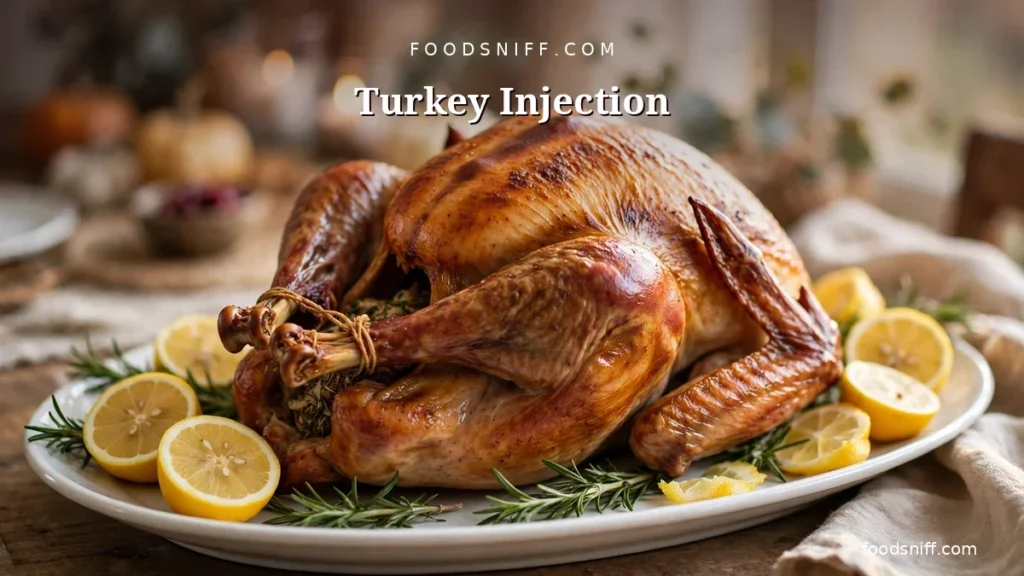
What Turkey Injection Is
Turkey injection is a butter based marinade pushed deep into the breast, thighs, and drumsticks with a meat injector, so flavor and moisture reach the center instead of sitting on the skin. This garlic butter version uses butter, broth, lemon, garlic, and herbs, makes about 1.5 cups in 15 minutes, and covers a 12 to 14 pound turkey.
A rub seasons the outside. A brine seasons the meat slowly from the outside in, over hours. An injection skips the wait and puts butter, broth, and seasoning straight into the thickest muscle, where dry turkey usually starts. The breast is the leanest part of the bird, and it dries out first in a long roast.
This recipe keeps the method simple. One saucepan, one injector, and a strainer are the only tools that matter.
Injection vs Brine: Which One Fits Your Thanksgiving
Brining and injecting solve the same problem in different ways, and the right pick depends on fridge space and schedule. A wet brine soaks the bird in salt water for 12 to 24 hours, and the salt helps the muscle hold moisture. A dry brine does the same work with salt rubbed on the skin over 24 to 72 hours, and it gives crisper skin.
Injection needs neither. You mix a warm butter liquid, push it into the meat, and cook the bird the same day. The flavor is stronger and more local than a brine, because it sits in pockets of butter instead of spreading evenly through every fiber. That is a fair trade when time is short.
| Method | Time needed | Flavor | Skin | Best for |
|---|---|---|---|---|
| Wet brine | 12 to 24 hours | Even, mild | Can go soft if not dried | A bird bought days ahead |
| Dry brine | 24 to 72 hours | Even, seasoned | Crisp | The best skin and deep seasoning |
| Injection | About 15 minutes | Bold, local | Stays crisp | A last minute bird or a fried turkey |
| Brine plus injection | 12 to 24 hours plus 15 minutes | Deep and bold | Crisp if dried | The fullest flavor, when salt is watched |
When Injection Wins
Injection wins when the turkey is already thawed and the clock is short. It also wins for fried turkey, where a wet brine leaves water on the skin that can spit in hot oil. A dry bird, patted well after injecting, goes into the fryer with far less risk.
When Brine Wins
Brine wins when you want even seasoning in every slice and you have a day to spare. It also wins for a very large bird, where an injector would need many fills and the flavor would still land in pockets.
If you brine and inject the same bird, count the salt from every layer. Foodie and Wine and Grill Masters Club both warn about this, and it is the easiest way to ruin a good turkey.
Picking an Injector That Will Not Clog
A meat injector is a large syringe with a hollow needle, and the cheap ones cause most of the trouble people blame on the recipe. The barrel should hold at least 2 ounces, so you are not refilling every few seconds.
Stainless steel injectors cost more and last longer. They clean well and the needle stays straight after a season of use. Plastic injectors work for one Thanksgiving, and they are fine if you only inject a bird once a year.
Stainless Steel vs Plastic
Pick stainless steel if you plan to inject every year, or if you smoke and fry turkeys and want a tool that survives hot liquids. Pick plastic if this is a one off experiment and you would rather spend the money on the turkey. Either way, buy a needle at least 2 inches long. A short needle only coats the surface, and the center of a thick breast never sees the butter.
Needle Length and Holes
A single hole needle puts all the liquid in one channel, which is fine for a small breast but easy to overfill. A multi hole needle has holes along the side near the tip, so it spreads the liquid as you pull back. It is the better choice for a whole turkey.
Whichever you own, strain the injection through a fine mesh sieve before you fill the barrel. Ground spices clump, fresh herbs catch, and one clog can turn a calm morning into a mess.
The Recipe: Garlic Butter Turkey Injection
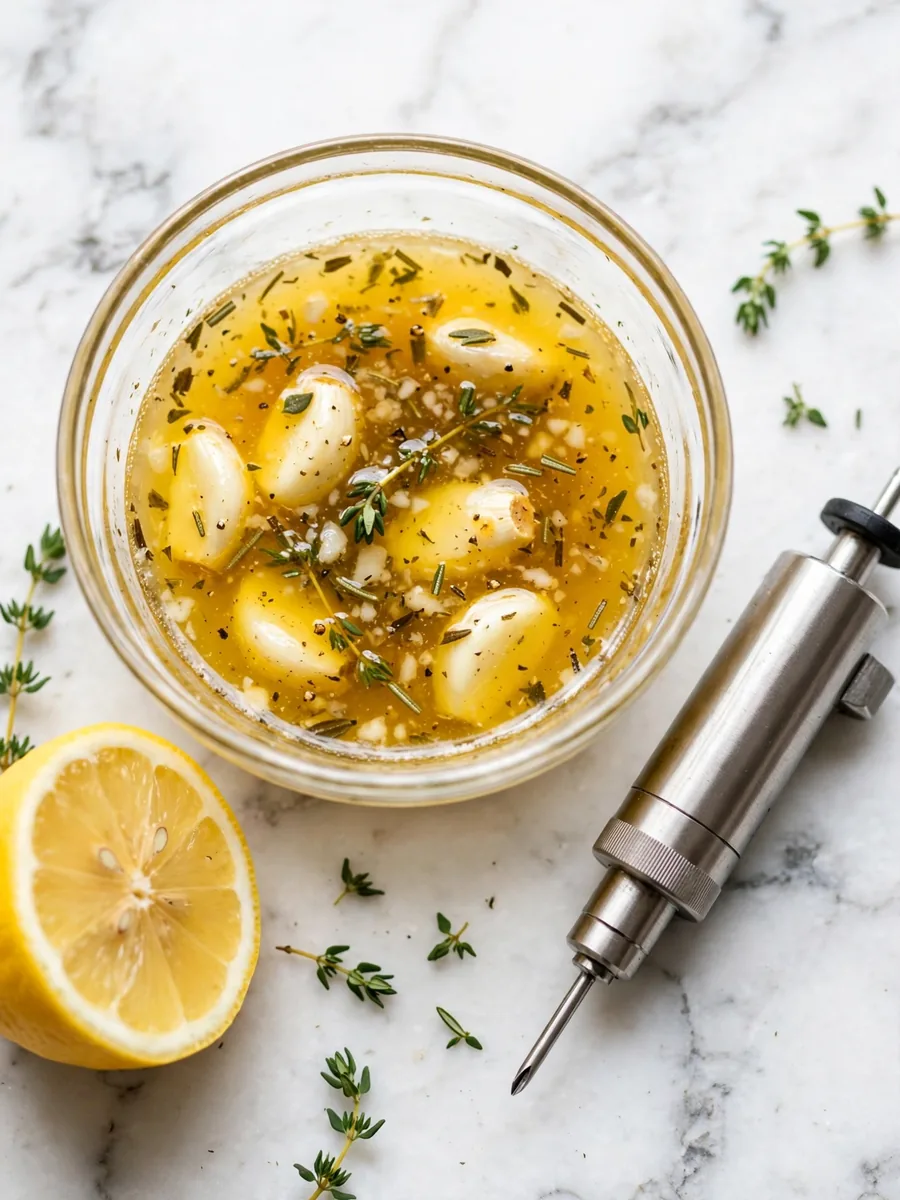
This is the base recipe. It leans classic: garlic, lemon, herbs, and a little heat from cayenne and red pepper flakes. The amounts follow First Home Love Life, whose cowboy butter version uses the same butter and broth ratio and the same 1 ounce per pound rule.
Prep time: 10 minutes | Cook time: 5 minutes | Total time: 15 minutes | Yield: about 1.5 cups, enough for a 12 to 14 pound turkey
Ingredients
- 1 cup unsalted butter
- 1/2 cup low sodium chicken broth
- 1 tablespoon Worcestershire sauce
- 1 tablespoon fresh lemon juice
- 1 teaspoon garlic powder
- 1 teaspoon onion powder
- 1 teaspoon smoked paprika
- 1/4 teaspoon cayenne pepper
- 1/4 teaspoon crushed red pepper flakes
- 1/2 teaspoon kosher salt
- 1/2 teaspoon black pepper
- 1 tablespoon finely chopped fresh parsley
- 1 teaspoon fresh thyme leaves
Steps
- Melt the butter in a small saucepan over low heat.
- Whisk in the chicken broth, Worcestershire sauce, lemon juice, garlic powder, onion powder, smoked paprika, cayenne, red pepper flakes, salt, and black pepper.
- Warm the mixture gently for 3 to 5 minutes, stirring often. Do not let it boil.
- Take it off the heat and stir in the parsley and thyme.
- Strain the warm mixture through a fine mesh strainer into a measuring cup. Throw away the solids.
- Let it cool slightly, but keep it warm enough to stay liquid. Fill a clean meat injector.
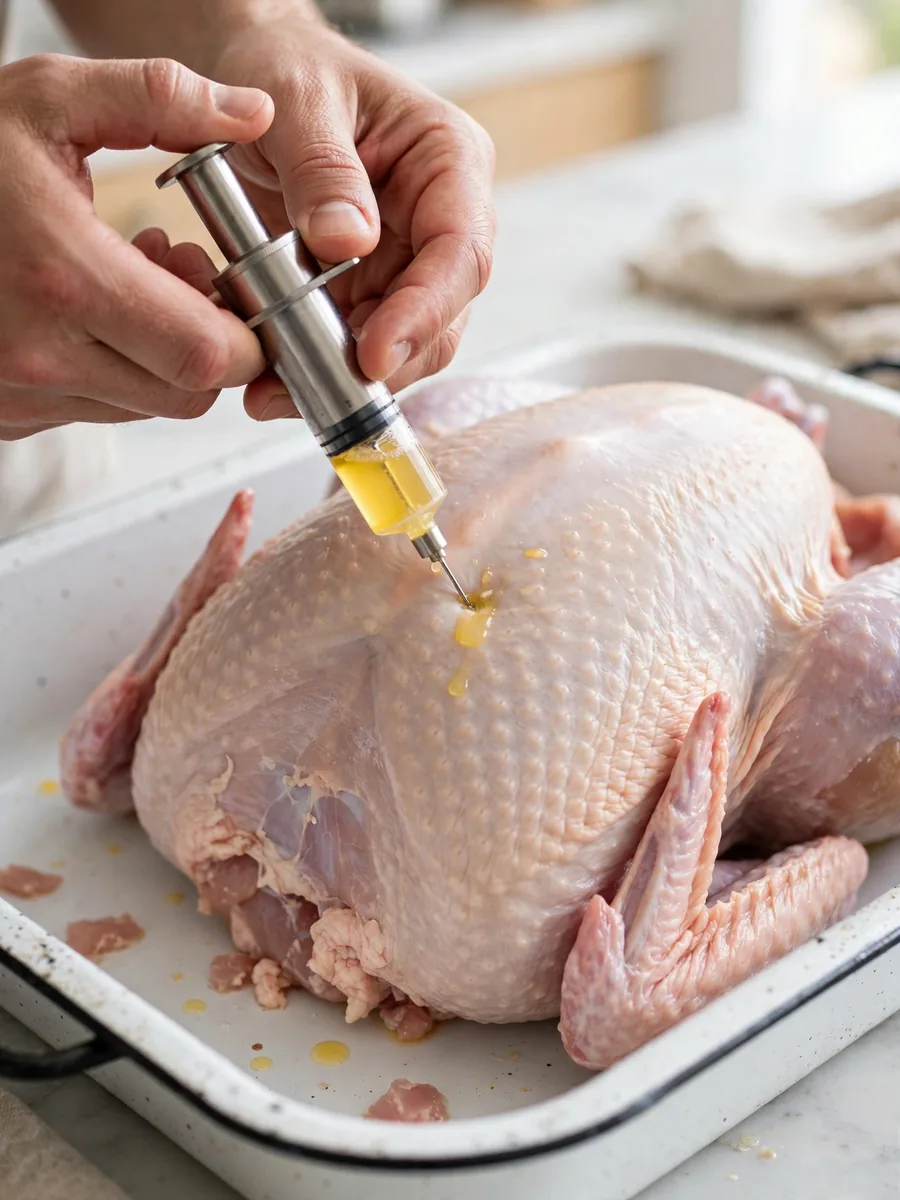
- Inject the turkey in several spots through the breasts, thighs, and drumsticks, using about 1 ounce of marinade per pound of turkey.
- Pat the turkey skin dry, season the outside as you like, and cook right away or refrigerate until ready to cook.
Keep the liquid warm while you work. Butter firms up as it cools, and a cold mix will clog the needle. If it starts to set, warm it gently over low heat and stir it again.
Two Flavor Variations From One Base
Once the base method works, the flavor is easy to change. Make one batch per bird, and pick the flavor that fits the rest of the meal.
Cajun Butter
Swap the smoked paprika for 2 teaspoons of Cajun or Creole seasoning and add 1 tablespoon of Louisiana style hot sauce. Dishes with Dad builds its Cajun injection on the same butter and stock base, with 2 tablespoons of Creole seasoning to a cup of stock. It works for roasted, smoked, and fried turkey.
Garlic Lemon
Double the lemon juice to 2 tablespoons, raise the garlic powder to 2 teaspoons, and leave out the cayenne and red pepper flakes. Foodie and Wine lists this as its bright version, and it suits a bird served with a light gravy and a citrusy side. The lemon keeps the butter from tasting heavy, which matters when the rest of the table is already rich.
How Much to Inject and Where It Goes
The most common mistake is putting most of the liquid in the breast and forgetting the legs. The breast is the biggest target, but the thighs dry out too, and the drumsticks are easy to reach. Split the batch by weight of meat, not by guesswork, and the flavor lands where the meat is thickest.
Use about 1 ounce of injection per pound of turkey, the rule First Home Love Life uses for a 12 to 14 pound bird. A 16 pound bird needs about a pint, so double the recipe. Butterball guidance quoted by Popular BBQ is stricter, at 1/2 ounce per 5 pounds in each thigh and each side of the breast. Start with the 1 ounce rule, and pull back if the meat leaks at every site.
| Part of the bird | Share of the liquid | Injection sites |
|---|---|---|
| Breast, each side | About 60 percent total | 4 to 6 spots per side |
| Thigh, each side | About 30 percent total | 2 to 3 spots per side |
| Drumstick, each side | About 10 percent total | 1 to 2 spots per side |
The Grid That Spreads Flavor
Work in a grid, with sites about 1 to 1.5 inches apart, the spacing Grill Masters Club recommends. Push the needle deep into the meat, then press the plunger slowly as you pull the needle back out. That lays a line of butter through the muscle instead of a single pocket.
One hole can serve three angles: push in, inject a little, turn the needle, inject a little more, and turn again.
When to Inject Your Turkey
Inject Before Cooking
Inject up to 24 hours ahead, the window First Home Love Life gives, and keep the bird covered in the refrigerator after. Foodie and Wine stretches that to 36 hours, but notes that the butter firms back up when cold, so the flavor gain from the extra day is small. If you inject the night before, pat the skin dry and season it right before cooking.
Inject During Cooking
Foodie and Wine offers a second option: wait until the bird hits 90F in the oven, then inject. Butter melts at 90F, so the liquid flows freely through the needle with no clogging. The trade off is a busy cooking schedule, since you have to open the oven, handle a hot bird, and get it back in quickly.
It is a good fix if the butter kept clogging on a cold bird, and a poor plan if the oven is already crowded.
Five Problems and the Fix for Each
Most injection trouble comes from liquid escaping, a blocked needle, and flavor landing in one spot.
Leaking Back Out
A little leakage is normal. Inject slowly while you pull the needle back, and use several small injections instead of forcing a lot of liquid into one spot. If a site keeps leaking, stop, wipe it, and move to a fresh site an inch away.
A Clogged Needle
A clog almost always means a solid got through. Strain the mix, grind dried herbs to a powder, and chop fresh herbs fine. If the needle clogs mid job, pull it out of the turkey first, then press hard over the cup or the sink to clear it. Clearing it while the needle is still in the meat can spray hot butter across the kitchen.
Uneven Flavor
Uneven flavor means the grid was too wide or the liquid pooled in one place. Go back over the bird with smaller amounts at more sites, and fan the needle at three angles from each hole. Stir the mix between fills, since butter and broth separate as they sit.
A salty bird usually means the turkey was already brined or enhanced, and the injection added salt on top of salt. Use unsalted butter, low sodium broth, and a salt free seasoning in that case.
A soggy skin usually means the bird went into the oven wet. Pat it dry after injecting, then let it sit uncovered in the fridge for 30 minutes before the rub goes on.
Small Turkeys and Turkey Breasts: Scaling Down
A whole turkey is not the only bird worth injecting. A 5 to 6 pound bone in turkey breast takes a half batch, the amount Dishes with Dad recommends, and it cooks in a fraction of the time. The method is the same: inject the thickest part of the breast in a small grid, pat dry, and cook to 165F.
For a single serving, a turkey breast steak takes a few teaspoons of warm injection, pushed in at two or three angles, and it needs no overnight rest. If you want a second bold main for the same table, a steak burrito brings the same kind of big flavor in a faster format.
Storing Leftovers and Reheating an Injected Turkey
An injected turkey stores like any cooked turkey, with one extra rule: never reuse leftover injection. Once the needle has touched raw meat, the liquid in the cup is no longer safe as a sauce. Throw it away.
Cool the carved turkey quickly and refrigerate it in shallow containers within two hours of cooking. It keeps for 3 to 4 days in the fridge.
Reheat slices gently in a covered dish with a splash of broth at 325F until the meat reaches 165F, the safe temperature in the USDA food safety guidance. The microwave works for single portions if you heat in short bursts and stop as soon as the meat is hot through.
What to Serve With It
A butter injected turkey is rich, so the sides should cut through it. Cranberry sauce, a sharp green salad, and roasted vegetables with a little acid all help. If the turkey is Cajun style, the pepper infused flavor in the meat pairs well with dirty rice or a simple cornbread.
For the grill, these smoky grilled turkey ideas show how a wood fired bird takes on flavor from the outside while the injection works from the inside. And when the spice blend runs low, these bold seasoning blends are a good place to start a fresh batch.
How far ahead can I inject a turkey?
You can inject a turkey up to 24 hours ahead. Keep it covered in the refrigerator after injecting, then pat the skin dry and season it right before cooking.
Can I inject a turkey and brine it?
Yes, but watch the salt. If the bird was brined or came pre-treated, use unsalted butter, low sodium broth, and a salt free seasoning in the injection, and leave the salt out.
Can I inject a frozen turkey?
No. The turkey must be fully thawed before you inject it. A frozen or partly frozen bird will not take the liquid evenly, and the needle cannot reach the thickest meat.
Can I reuse leftover turkey injection marinade?
No. Once the needle has touched raw turkey, throw away any injection left in the cup. Make a fresh batch if you want butter to spoon over the cooked turkey.