Skip to content


Tartine gingerbread cookies are soft, dark, heavily spiced cookies from Tartine Bakery in San Francisco, made with blackstrap molasses, cocoa, ginger, cloves, cinnamon, and black pepper. The dough chills overnight, rolls 1/3 inch thick, and bakes 7 to 15 minutes at 350F. A thin sugar glaze brushed on while warm gives the shiny finish.
This is the bakery recipe, from Liz Prueitt, the pastry chef and co-owner of Tartine Bakery, published in the Tartine cookbook. The amounts below match that published recipe exactly, and where other sites print different amounts, this guide says so.
The recipe asks for one thing most gingerbread recipes do not: an overnight chill. That wait is the whole point. The dough firms up, the spices settle into the molasses, and the next day it rolls clean and holds its shape.
What makes Tartine’s gingerbread different
Tartine Bakery sits in the Mission District of San Francisco, and its gingerbread has been a holiday favorite there for years. The recipe is built like a bakery recipe, with more spice and more salt than a home version.
Black pepper, the surprise ingredient
The first difference is black pepper. Most gingerbread uses ginger, cinnamon, and cloves, and stops there. Tartine adds 1 1/4 teaspoons of freshly ground black pepper, and it is the ingredient people notice without naming it. It gives the cookie a warm bite, and it keeps the sweetness from taking over.
Cocoa for color and depth
The second difference is cocoa. One tablespoon of cocoa powder darkens the cookie and deepens the molasses flavor, but it does not make the cookie taste like chocolate. It works the way coffee works in a chocolate cake, by pushing the dark flavors forward.
A glaze instead of royal icing
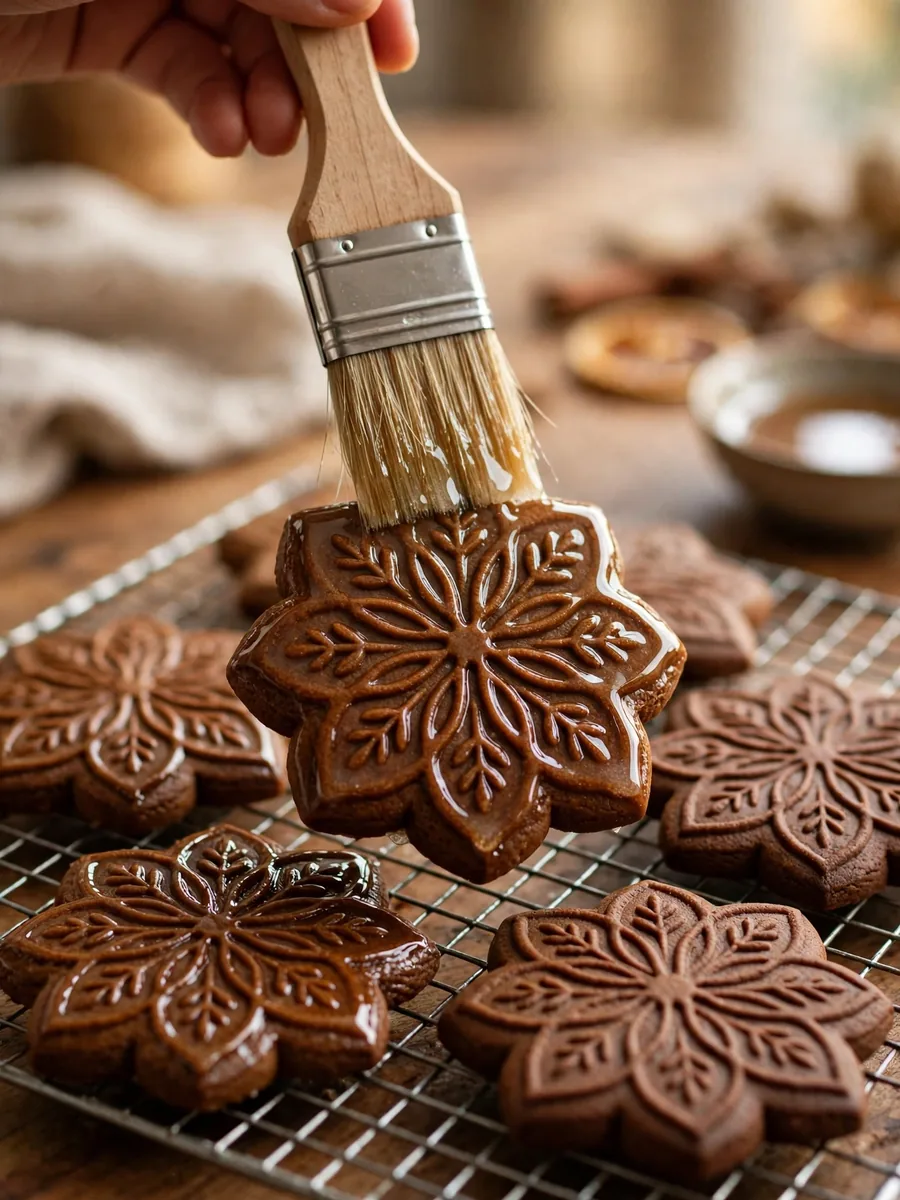
The third difference is the finish. There is no royal icing and no piped decoration. The cookies get a thin glaze of confectioners sugar and water, brushed on while they are still warm. It dries to a shiny, opaque coat that settles into the pattern on top. Tartine Bakery’s official site is the home of the bakery behind the recipe.
| Feature | Tartine gingerbread | Regular gingerbread |
|---|---|---|
| Spice lead | Ginger, cloves, cinnamon, black pepper | Ginger, cinnamon, cloves |
| Sweetener | Blackstrap molasses, light corn syrup | Molasses, often brown sugar |
| Color | Dark, from cocoa and molasses | Medium brown |
| Chill | Overnight, required | 30 minutes to 1 hour, or none |
| Thickness | 1/3 inch | 1/4 inch or thinner |
| Finish | Thin sugar glaze, brushed on warm | Royal icing, piped |
| Texture | Soft center, lightly golden edges | Often crisp or snappy |
That soft center is the signature. The cookies bake until the sides turn lightly golden while the centers are still soft to the touch, and they firm up as they cool. Pull them too late and you get a crisp cookie instead, which is fine, but it is not the Tartine texture.

Tartine gingerbread cookie recipe
Prep time: 30 minutes, plus overnight chilling
Cook time: 15 minutes
Serves: 24 cookies
Why this recipe leads the guide
This recipe leads because it is the published Tartine recipe, with complete amounts and a named author, and every other version online traces back to it. Food.com printed it from Liz Prueitt in 2012, and the same amounts appear in the Tartine cookbook.
The amounts below are the Food.com version exactly. TastyAZ uses 4 cups of flour instead of 3 3/4 cups, and 1/3 cup plus 2 tablespoons of molasses instead of 1/2 cup, and it yields 20 cookies instead of 24. The Fond Life keeps the amounts but rolls the dough to 1/8 inch instead of 1/3 inch.
Those changes are small, but they change the cookie. More flour makes a drier dough, less molasses makes a milder cookie, and a thinner roll makes a crisper one. Use the amounts below and roll to 1/3 inch.
Ingredients
- 3 3/4 cups all-purpose flour
- 1 tablespoon cocoa powder
- 4 teaspoons ground ginger
- 1 1/2 teaspoons ground cloves
- 2 teaspoons ground cinnamon
- 1/2 teaspoon baking soda
- 1 teaspoon salt
- 1 1/4 teaspoons black pepper, freshly ground
- 1 cup unsalted butter, at room temperature
- 3/4 cup plus 2 tablespoons granulated sugar
- 1 large egg
- 1/2 cup blackstrap molasses
- 2 tablespoons light corn syrup
- For the glaze: 1 cup confectioners sugar
- For the glaze: 2 tablespoons water
Steps
- Stir together the flour, cocoa powder, ginger, cloves, cinnamon, baking soda, salt, and pepper in a mixing bowl. Set the bowl aside.
- Beat the butter in a stand mixer fitted with the paddle attachment on medium-high speed until creamy. Slowly add the granulated sugar and mix on medium speed until completely smooth and soft. Scrape down the sides of the bowl as needed.
- Add the egg and mix well. Add the molasses and corn syrup and beat until incorporated. Scrape down the sides of the bowl again.
- Add the flour mixture and beat on low speed until a dough forms that pulls away from the sides of the bowl.
- Remove the dough from the bowl, flatten it on a large piece of plastic wrap into a rectangle about 1 inch thick, cover it with the plastic wrap, and refrigerate overnight.
- Preheat the oven to 350F. Line a baking sheet with parchment paper or a nonstick liner.
- Unwrap the dough and place it on a floured work surface. Roll it out 1/3 inch thick. If using a cookie mold, lightly dust the top with flour, press the mold over the dough, and cut out the shapes with a small knife, spacing them about 1 inch apart on the prepared baking sheet.
- If using a patterned rolling pin, lightly dust the lined baking sheet with flour and transfer the dough to the pan. Dust the top of the dough with flour and roll it into a rectangle about 1/3 inch thick with a plain pin. Then roll over the dough with the patterned pin, pressing hard enough to leave a clear impression. Trim the sides with a small knife.
- Bake until lightly golden along the sides but still soft to the touch in the centers, 7 to 15 minutes. The timing depends on the size of the cookies, or on whether you baked a single large patterned piece to cut after baking.
- While the cookies bake, whisk together the confectioners sugar and water in a small bowl until smooth. Sift the sugar first if it looks lumpy, since lumps show on the finished cookie.
- Remove the cookies from the oven and let them cool on the pan on a wire rack for about 10 minutes. Then, while the cookies are still warm, brush a light coat of glaze on the top of each cookie with even strokes, covering it evenly.
- Let the cookies cool completely. The glaze dries to a shiny, opaque finish. If you baked a single large patterned piece, cut it into the desired sizes with a small, very sharp knife. At the bakery, they cut 3-by-4-inch rectangles, but 1 1/2 by 4 inches makes a nice smaller size.
One cookie works out to about 214 calories, using the Chef’s Resource figure of 213.9 calories per cookie for this exact recipe at a 24-cookie yield. Smaller cookies, a thinner roll, or a lighter glaze all lower it.
How to glaze the cookies
The glaze is two ingredients and one rule: brush it on while the cookies are still warm. Warm cookies take the glaze in a thin, even coat, and it dries shiny. Cold cookies leave the glaze sitting on top, thick and dull.
Whisk the confectioners sugar and water until smooth, and sift the sugar first if it has lumps. The Fond Life found that sifting was a necessary step, since Tartine only says to whisk until smooth, and lumps ruin an embossed cookie.
Use a pastry brush and even strokes, and cover the whole top. A thin coat is enough. If the glaze pools in the grooves of a pattern, wipe the brush on the side of the bowl before the next cookie.
Rolling thickness and the patterned pin
Thickness is the one choice that changes the cookie most. Tartine calls for 1/3 inch, which is thick for a rolled cookie, and that thickness is what keeps the centers soft.
1/3 inch vs thinner
Roll to 1/3 inch for the bakery cookie: soft in the middle, lightly golden at the edges, and thick enough to hold an embossed pattern. The Fond Life rolled to 1/8 inch instead and preferred it, since she found 1/3 inch too thick. Her version baked faster and came out crisper.
Both are right, for different cookies. Keep 1/3 inch if you want soft and chewy. Roll to 1/4 inch for a middle ground, or to 1/8 inch for a crisp cookie that snaps. Do not go thinner than 1/8 inch, since the cookie dries out.
Cookie cutters, molds, and the patterned pin
A patterned rolling pin, sometimes sold as a springerle pin, presses a design into the dough, and the glaze settles into the grooves. It is the easiest method, since you roll the whole sheet, press the pattern, bake it as one piece, and cut it after baking.
Cookie molds work the same way on single cookies. Press the mold over the dough, cut around it with a small knife, and place the shapes on the sheet about 1 inch apart. A cookie stamp and a biscuit cutter slightly larger than the stamp give the same effect.
Plain cookie cutters work too. Cut stars, trees, or gingerbread men from the rolled dough and bake them the same way. Cutters are the best choice for baking with children, since no special equipment is needed.
No pin? Bake the whole sheet
If you own no patterned pin and no molds, roll the dough into a rectangle on the lined baking sheet, trim the sides, and bake it as one large piece. Cut it into rectangles with a small, very sharp knife once it has cooled and the glaze has dried.
Soft vs crisp: how bake time controls texture
The recipe gives a bake range of 7 to 15 minutes for a reason. Size and thickness decide the time, and the visual cue matters more than the clock: the cookies are done when the sides turn lightly golden and the centers are still soft to the touch. Large 3 by 4 inch rectangles need 12 to 15 minutes, while 2 1/2 inch shapes need about 9.
For a soft, chewy cookie, pull the tray early. The Fond Life’s 2 1/2 inch cookies took exactly 9 minutes, and TastyAZ and LilyPCrumbs both bake for 9 minutes at the same size. The cookies keep firming up after they leave the oven, so a soft center on the tray sets into a chewy cookie on the rack.
For a crisp cookie, leave the tray in until the middle starts to firm up. A thinner roll helps too, since a 1/8 inch cookie crisps where a 1/3 inch cookie stays soft. Do not wait for the tops to brown, since the color comes from the molasses, not the bake.
How to scale the recipe
Scale by multiplying every amount by the same number, and keep the spice ratios intact. The baking soda and salt must scale with the flour, or the cookies spread or taste salty.
| Batch | Flour | Butter | Molasses | Yield |
|---|---|---|---|---|
| Half | 1 7/8 cups | 1/2 cup | 1/4 cup | About 12 cookies |
| Single | 3 3/4 cups | 1 cup | 1/2 cup | 24 cookies |
| Double | 7 1/2 cups | 2 cups | 1 cup | About 48 cookies |
A double batch needs a large mixer bowl, or two batches mixed separately. The dough keeps its shape better if you mix in two batches. Bake one tray at a time and keep the rest of the dough chilled.
For a small batch, halve every amount, including the glaze. A half batch makes about 12 cookies, which suits a single gift tin or a first try. The chill and bake times stay the same, since the cookie size does not change.
Variations
Chai spice and espresso frosting
LilyPCrumbs ran a bakeoff of 8 gingerbread recipes, judged Tartine’s the best, and then combined it with Half Baked Harvest’s chai spice and espresso frosting. The chai topping mixes cinnamon, ginger, cardamom, nutmeg, allspice, and cloves with sugar, sprinkled over the cookies before baking.
The espresso frosting replaces the sugar glaze: melted butter, powdered sugar, instant espresso, and heavy cream, whisked smooth and spread on the cooled cookies.
Chocolate gingerbread
Replace 2 tablespoons of the flour with Dutch cocoa for a deeper chocolate note, and finish with a white chocolate drizzle instead of the sugar glaze. Keep the black pepper in, since it is what makes the chocolate version taste like gingerbread and not like a brownie.
Citrus and shaped cookies
Add the zest of one orange to the dough for a brighter cookie, and swap the water in the glaze for orange juice. The citrus lifts the molasses without changing the method or the bake time. Our spiced cookies use orange in a similar way.
For gingerbread men and shaped cookies, roll to 1/3 inch and cut with cutters, then bake about 9 minutes for 2 1/2 inch shapes. Small shapes bake faster than rectangles, so check them at 7 minutes.
Make-ahead guide
Most of the work happens the day before you bake. The dough needs its overnight chill, and everything else is quick on bake day.
The day before: dough and setup
Make the dough the day before and refrigerate it overnight, wrapped in plastic. That is the Tartine method, and it is also the least stressful way to bake. The Fond Life calls making the dough a day ahead a must.
Roll the dough out before chilling if you have the space, as The Fond Life recommends. Lay the rolled sheet between pieces of wax paper and chill it flat. Cold dough is hard to roll, so rolling first saves a fight the next morning.
Bake day: roll, bake, glaze
Set out the baking sheets, parchment, rolling pin, and cutters in the morning. If the dough chilled as a block, let it sit at room temperature for 15 to 20 minutes before rolling. If it chilled flat, take it straight from the fridge.
Roll, cut, and bake in batches, and glaze each tray while it is still warm. Let the cookies cool completely before stacking them, since warm cookies stick together and the glaze smears.
How to store and freeze
Storage depends on whether the cookies are glazed. Plain cookies freeze better than glazed ones, and the glaze does not like condensation, so freeze before glazing when you can. Store glazed cookies at room temperature, since the fridge dries them out.
| Where | How | How long |
|---|---|---|
| Room temperature, glazed | Airtight tin, layered with parchment | About 2 weeks |
| Room temperature, plain | Airtight container | About 2 weeks |
| Fridge | Airtight container | 3 to 4 weeks |
| Freezer, baked plain | Freezer bag or rigid container | Up to 3 months |
| Freezer, dough | Wrapped flat, then bagged | Up to 3 months |
How long they keep
TastyAZ and Captain Tummy both give about 2 weeks in an airtight container at room temperature. Survival Freedom gives 2 to 3 weeks at room temperature and 3 to 4 weeks in the fridge.
The Kitchn gives 3 days for baked cookies in general, but gingerbread keeps longer because it is low in moisture and high in sugar. Use the shortest time that fits your batch.
How to keep soft cookies soft
To keep soft cookies soft, tuck a slice of white sandwich bread into the container, as The Kitchn recommends. The moisture in the bread moves into the cookies. Store crisp cookies separately from soft ones, since the moisture from a soft cookie will soften a crisp one overnight.
Freezing dough and baked cookies
To freeze the dough, wrap the flattened slab in plastic wrap, then in foil, and label it with the date. Thaw it overnight in the fridge, then roll and bake.
To freeze baked cookies, cool them completely, pack them in a rigid container with parchment between layers, and thaw them in the closed container so condensation forms on the container, not on the cookies. Glaze after thawing.

Troubleshooting
Most gingerbread problems show up before the cookies cool. The table covers the common ones, with the fix for each.
| Problem | Likely cause | Fix |
|---|---|---|
| Dough too hard to roll | Chilled overnight as a block | Let it sit 15 to 20 minutes at room temperature; do not microwave it; roll before chilling next time |
| Cookies spread in the oven | Dough too warm, oven too cool | Chill the cut shapes 10 minutes before baking; check the oven temperature |
| Cookies came out hard | Overbaked, or rolled too thin | Pull them while centers are still soft; roll to 1/3 inch next time |
| Glaze is clumpy | Confectioners sugar not sifted | Sift the sugar before whisking; whisk until fully smooth |
| Design faded in the oven | Pattern pressed too lightly | Press the pin firmly and dust with flour first; chill cut shapes before baking |
| Cookies taste too bitter | Blackstrap molasses too strong | Use dark molasses next time; it is milder and sweeter |
What to serve with them
These cookies belong on a holiday cookie tray, where their dark color and shiny glaze stand out next to paler cookies. Put them beside our snowball cookies, which are pale, buttery, and rolled in powdered sugar. Keep them in their own group, since the glaze can stick to the neighbors.
Serve them with hot coffee, black tea, or cocoa. For a cookie swap, pack them in a tin with parchment between layers, and add a few of our butter cookie recipe for cookie press cookies for contrast, since pressed butter cookies are pale and crisp where these are dark and soft.
For a family baking day, pair the bake with our christmas cookie painting guide, so children can decorate their own cookies while the Tartine batch cools. For another bakery-style bake, try our bakery style cookies.
Frequently asked questions
Do I have to chill the dough overnight?
Tartine says to refrigerate the dough overnight. TastyAZ chills 8 hours and LilyPCrumbs 4 hours minimum, so a shorter chill works, but the dough is softer and the pattern holds less well. Rolling the dough out before chilling, as The Fond Life recommends, makes the next day easier.
Can I use cookie cutters instead of a patterned rolling pin?
Yes. The flavor is the same, and the glaze still gives the shiny finish. The patterned rolling pin is for the embossed look, not the flavor. Cut stars, trees, or gingerbread men at 1/3 inch thick and bake about 9 minutes for 2 1/2 inch shapes.
How long do gingerbread cookies last?
About 2 weeks in an airtight tin at room temperature, and 3 to 4 weeks in the fridge. Baked plain cookies freeze up to 3 months, and the dough freezes up to 3 months wrapped flat. Glaze after thawing, since the glaze does not like condensation.
Can I freeze gingerbread cookie dough?
Yes. Wrap the flattened dough slab in plastic wrap, then in foil, label it with the date, and freeze it up to 3 months. Thaw it overnight in the fridge, then roll and bake as usual. Baked plain cookies also freeze up to 3 months in a rigid container; glaze them after thawing.