Skip to content


Butter cookies for a cookie press are small, crisp, buttery cookies squeezed through a press into trees, wreaths, and rosettes. This recipe uses one cup of butter, two egg yolks, vanilla and almond extract, and two cups of flour, and it makes about 60 cookies in roughly 30 minutes, with no chilling before pressing.
A cookie press turns a plain butter dough into a tin full of neat shapes in one afternoon. No rolling pin, no cutters, no chilling. You mix the dough, load the press, and squeeze out one shape after another.
This guide gives you one complete recipe, then the technique around it: dough temperature, loading the press, troubleshooting, scaling, and decorating. Every amount comes from a named source, and the calorie figure matches the recipe exactly.
What butter cookies for a cookie press are
Butter cookies for a cookie press, also called spritz cookies, are small, crisp cookies squeezed through a press fitted with a patterned disc. The dough is soft, rich in butter, and lightly sweet, with vanilla and almond extract for flavor. It holds a sharp shape in the oven instead of spreading flat.
The name comes from the German word spritzen, to squirt, and the cookie is Spritzgebäck in Germany, a Christmas baking tradition. Wikipedia describes it as a crisp, fragile, buttery biscuit made by squeezing dough through a press fitted with patterned holes, or through a pastry bag with a nozzle.
These are not cut-out cookies. Cut-out dough is rolled flat and chilled so a cutter keeps its edge, while press dough stays soft at room temperature and never sees a rolling pin. That one difference changes the whole method, so do not swap the two kinds of dough. Our shaped cookies include orange fish cookies, which are rolled out, chilled for an hour, and cut with a fish-shaped cutter.
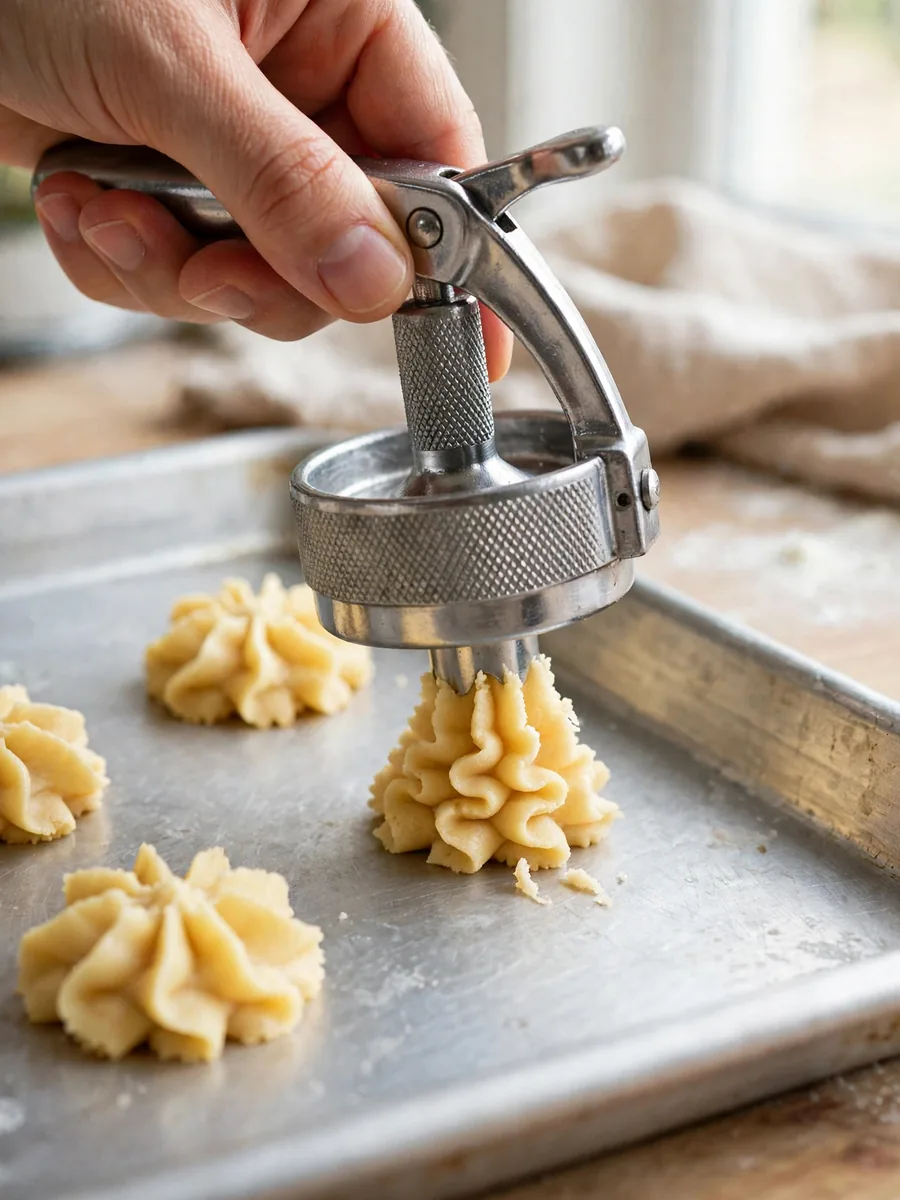
Butter cookie press recipe at a glance
Five well-known versions of this recipe use nearly the same ingredients, so the differences are small but they matter. The table compares them, so you can see why the lead recipe below uses egg yolks and no leavening.
| Version | Eggs | Leavening | Oven | Bake | Yield |
|---|---|---|---|---|---|
| Lead recipe, Dear Crissy | 2 yolks | None | 350 F | 6 to 8 minutes | 60 cookies, 53 kcal each |
| The Kitchn spritz cookies | 1 whole egg | None | 350 F | 8 to 12 minutes | About 100 cookies |
| Allrecipes Butter Cookies II | 1 whole egg | None | 400 F | 8 to 10 minutes | Chill dough 1 hour first |
| Love and Lemons spritz cookies | 1 whole egg | 1/2 tsp baking powder | 375 F | 8 to 10 minutes | 45 cookies |
| Savory Experiments spritz | 2 yolks | None | 350 F | About 7 minutes | 97 kcal per cookie |
Classic butter cookie recipe for a cookie press
Prep time: 20 minutes
Cook time: 8 minutes per sheet, about 30 minutes for the full batch
Serves: 60 cookies
Why this recipe leads the guide
This recipe leads because it is the simplest version that still tastes like a classic spritz cookie, and its nutrition figure matches its own amounts. Dear Crissy publishes 53 calories per cookie for this exact recipe, so the number on this page belongs to the dough you are actually making.
Egg yolks do the work here. They give richness and color without the extra water a whole egg white brings, so the dough stays soft enough to press and firm enough to hold a shape. No baking powder means no lift and no spread, which keeps trees looking like trees.
The almond extract is light, just a quarter teaspoon, so the cookies taste of butter first and almond second. Leave it out if you do not like almond, and use an extra half teaspoon of vanilla instead.
Ingredients
- 1 cup unsalted butter, softened
- 2/3 cup granulated sugar
- 2 large egg yolks
- 1 teaspoon vanilla extract
- 1/4 teaspoon almond extract
- 2 cups all-purpose flour, spooned and leveled
- 1/4 teaspoon salt
- Colored sugars or sprinkles, for decorating
Steps
- Preheat the oven to 350 F. Put two unlined, ungreased baking sheets in the fridge to chill while you mix the dough.
- Beat the softened butter and sugar in a large bowl with an electric mixer on medium speed until light and fluffy, about 2 to 3 minutes.
- Beat in the egg yolks, vanilla extract, and almond extract until just combined. Scrape down the sides of the bowl.
- Add the flour and salt a little at a time, mixing on low speed until a soft dough forms. Do not overmix, or the cookies can turn tough.
- Fit the disc you want into the cookie press. Roll the dough into a log a little narrower than the barrel and slide it in, packing it down with the back of a spoon so no air pockets stay inside.
- Hold the press flat against a chilled, ungreased baking sheet and click once. Pause a second, then lift straight up. Press the cookies about an inch apart, one shape per sheet.
- Sprinkle with colored sugar or sprinkles before baking, if you want them.
- Bake 6 to 8 minutes, until the edges just begin to brown. Let the cookies rest on the pan for 3 to 5 minutes, then move them to a wire rack to cool. Let each sheet cool completely before pressing the next batch.
One cookie works out to about 53 calories, using the Dear Crissy nutrition figure for this exact recipe. The figure covers plain cookies without sprinkles or a chocolate dip, so decorated cookies run a little higher.
How to use a cookie press
The press does the shaping, but the dough and the sheet decide whether it works. Get those two right and the rest is rhythm: load, click, lift, repeat.
Dough temperature comes first
Butter should be soft enough to dent with a finger, about 65 to 67 degrees F, but still matte, never shiny or greasy. Emma’s Cake Studio puts the target at about 67 degrees F for the same reason: cold butter jams the press, and warm butter slumps in the oven.
Do not chill this dough before pressing. Cold dough will not pass through the disc, and forcing it can break a plastic press. Chew Out Loud, Baked AI, and Eat Healthy 365 all give the same rule, and the press maker’s own instructions say the same thing.
The one exception is a kitchen so warm the dough turns greasy. Then chill the filled barrel for 5 to 10 minutes only, never longer, and knead the dough briefly so its temperature is even before you press again.
Loading the press
Roll the dough into a log a little narrower than the barrel, so it slides in without air pockets. Pack it in with the back of a spoon as you go. Air pockets make the first cookies from each load come out lopsided, so scrape those back into the bowl and press again.
Fit the disc you want, screw the cover on tight, and push the plunger down until no room is left in the chamber. Load a little dough at a time if you want to switch discs, since a half-full barrel is easier to change than a full one.
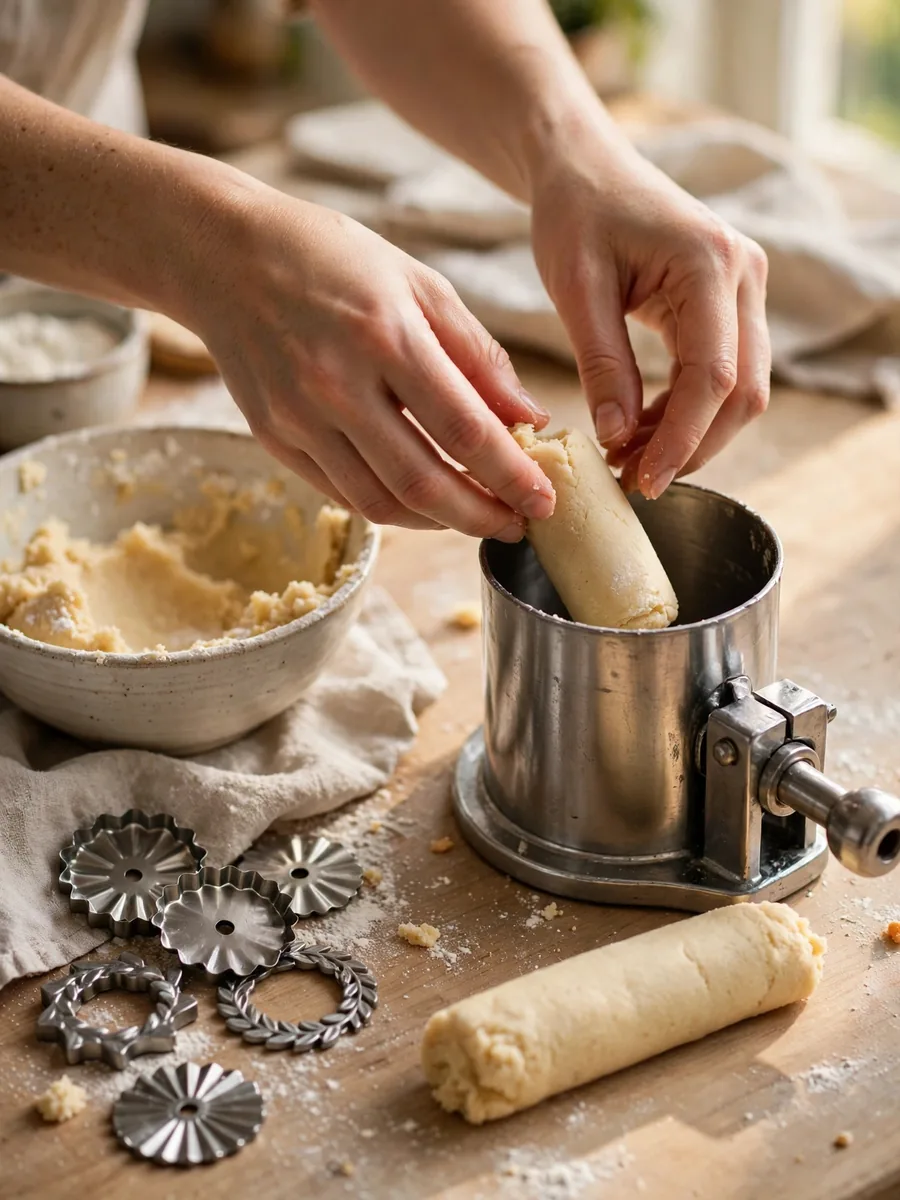
Pressing one clean cookie
Hold the press flat against a cool, bare metal sheet and click once. Pause a second, then lift straight up without twisting. The cookie stays behind because the dough grips the bare metal harder than it grips the disc.
Use unlined, ungreased sheets, and chill them in the fridge while you mix the dough. Parchment, silicone mats, grease, and nonstick coatings are all too slippery, so the shape lifts off with the press. A warm sheet is just as bad: it softens the butter on contact and smears the shape.
Press one shape per sheet, since trees and wreaths bake at slightly different rates. Space the cookies about an inch apart. They barely spread, so a full sheet holds a lot of cookies, and you can press close together.
Choosing a cookie press
A metal barrel holds up better to stiff butter dough than a thin plastic one, and a trigger that clicks firmly keeps every cookie the same size. Parade’s writer tried a cheap metal press that broke after one cookie, while her mother had recommended the OXO Good Grips press from the start.
You do not need the most expensive press. You need one with a barrel that fits your hand, discs that lock in tight, and a trigger that moves smoothly. If the trigger sticks, the dough comes out in uneven bursts.
Troubleshooting
Most press problems come from two things: dough temperature and the sheet. Fix those first, and the rest is practice.
| Problem | Likely cause | Fix |
|---|---|---|
| Dough will not come out | Too cold, or too much flour | Let the barrel sit 10 minutes at room temperature, then work in milk a teaspoon at a time |
| Shapes lift off the sheet | Sheet lined, greased, warm, or nonstick | Use a cool, bare aluminum sheet and hold the press flat against it |
| Shapes spread and lose detail | Butter too warm, dough too soft | Chill the filled barrel 5 minutes and cool the sheets completely |
| Uneven sizes | Press tilted, or air pockets in the barrel | Keep the press flat and upright, one click per cookie, pack the barrel snugly |
| Dough crumbly | Too much flour, or butter too cold to cream | Knead a piece in your hands, then work in a teaspoon of milk if it still cracks |
Dough will not come out of the press
The dough is too cold or has too much flour. Let the filled barrel sit at room temperature for 10 minutes, then knead a piece briefly in your hands. If it still will not move, work in a tablespoon of milk, a teaspoon at a time.
Shapes lift off the sheet
The sheet is lined, greased, warm, or nonstick. Switch to a cool, bare aluminum sheet and hold the press flat against it. Chill the sheet in the fridge for 10 to 15 minutes if the kitchen is warm.
Shapes spread and lose detail
The butter was too warm or the dough too soft. Chill the filled barrel for 5 minutes, cool the sheets completely, and check the dough feels like soft modeling clay, not sticky paste. Add a tablespoon of flour only if chilling does not fix it.
Cookies bake unevenly
Different shapes bake at different rates, and a warm sheet starts the next batch too early. Keep one shape per sheet, rotate the sheets halfway through, and let each sheet cool completely before pressing the next batch. Start checking at 6 minutes.
Flavor variations
Change one thing at a time, and keep the butter, sugar, and flour the same. The press does not care about flavor, but the dough balance does.
Chocolate spritz cookies
Replace 1/4 cup of the flour with unsweetened cocoa powder and add an extra tablespoon of sugar. The dough turns darker and a little drier, so press a test cookie first. Top with white sprinkles, or dip the cooled cookies in melted white chocolate.
Lemon spritz cookies
Add the finely grated zest of one lemon and swap the almond extract for lemon extract. Cookies by Bess bakes a lemon spritz with a full pound of butter and a lemon glaze, and the same idea works here at a smaller scale: zest in the dough, glaze on top.
Peppermint spritz cookies
Swap the almond extract for peppermint extract and tint half the dough red with gel food coloring. Press candy-cane stripes by loading red and white dough side by side in the barrel, and finish with crushed candy canes after baking.
Cream cheese spritz cookies
Beat 3 ounces of softened cream cheese in with the butter for a softer, richer cookie that stays tender for days. The dough is slightly softer, so keep the sheets cold and the kitchen cool. This is the version to make when the cookies need to travel in a tin.
How to scale the recipe up or down
Scale by multiplying every ingredient by the same number and keeping the ratios intact. The press cares about dough texture, not batch size, so a half batch presses exactly like a double batch.
| Batch | Butter | Sugar | Egg yolks | Flour | Yield |
|---|---|---|---|---|---|
| Half | 1/2 cup | 1/3 cup | 1 | 1 cup | About 30 cookies |
| Single | 1 cup | 2/3 cup | 2 | 2 cups | About 60 cookies |
| Double | 2 cups | 1 1/3 cups | 4 | 4 cups | About 120 cookies |
Small batch for one tin
For a half batch, use one yolk and work in a teaspoon of milk if the dough feels stiff. It makes about 30 cookies, enough for one tin or one cookie exchange, and the dough presses the same way.
The half batch is the smallest size worth pressing. A quarter batch leaves too little dough to fill the barrel well, so the press sputters and the shapes come out uneven.
Decorating and serving
Spritz cookies look finished before you decorate them, so keep the decorating light. A little color goes further than a heavy hand.
Decorating before baking
Add colored sugar, sanding sugar, or nonpareil sprinkles before the cookies go in the oven, so they stick. Skip quins, the flat confetti sprinkles, since they can melt during baking. The Kitchn gives the same warning, and it is worth following.
Decorating after baking
Dip cooled cookies halfway in melted dark chocolate and add chopped nuts or sprinkles before it sets. A thin powdered-sugar glaze with lemon juice works too, the way Cookies by Bess finishes its lemon spritz. Let dipped cookies set on parchment before stacking them.
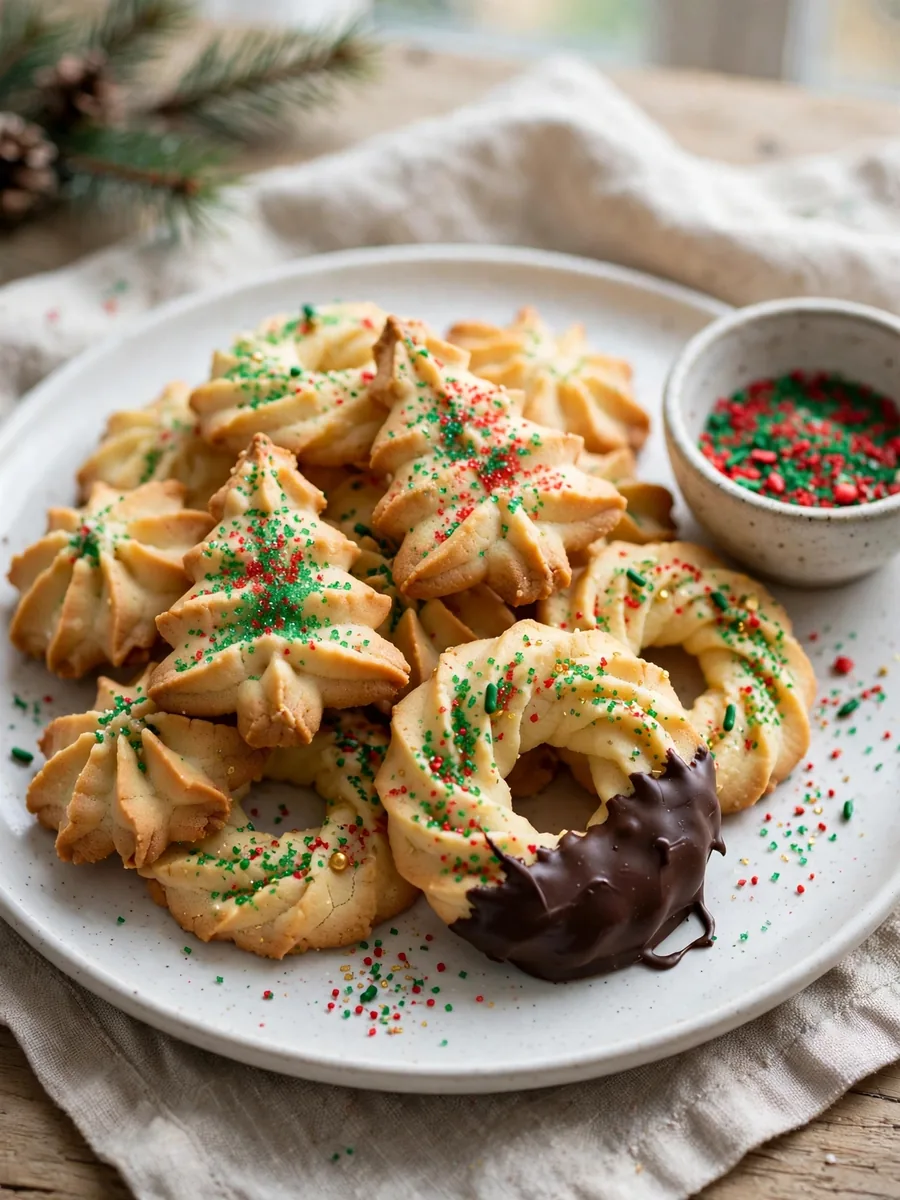
Building a cookie tin
A tin of these cookies travels well because the shapes are sturdy once they cool. Layer them with parchment paper, put the sturdiest shapes at the bottom, and keep the tin at room temperature. Our snowball cookies, round nut cookies rolled in powdered sugar, sit well beside pressed cookies in the same tin, since the two shapes and flavors are different.
For a holiday tray, press three shapes in two colors and add one dipped variety. That gives six looks from one dough, and the tray reads as planned instead of random. For kids who want to decorate, our guide to painting Christmas cookies gives them a second activity once the pressing is done.
What to serve with them
Serve pressed butter cookies with tea, coffee, or cold milk, the way any crisp butter cookie wants to be eaten. They are small by design, about 53 calories each, so a plate of six is a reasonable serving with coffee after dinner.
They also fit a dessert table beside richer sweets, where their crisp, light texture balances chocolate cake and creamy desserts. The same creaming step starts most baking with butter, including our 2 banana bread recipe, so the technique here carries over to other bakes. Our cookie recipes include the viral crookie, a croissant and cookie mashup, for bakers who want a second project from the same afternoon.
Storage and freezing
Baked spritz cookies keep up to 5 days in an airtight container at room temperature, following The Kitchn, and Love and Lemons gives up to a week. Layer them with parchment paper so the decorations do not smudge, and keep the tin away from heat.
Freeze undecorated cookies for up to 3 months in a freezer bag with parchment between the layers. Thaw at room temperature, then decorate. Raw dough freezes for up to 1 month wrapped tight; thaw it overnight in the fridge, then let it come to room temperature before pressing, since cold dough will not pass through the press.
Do not refrigerate the baked cookies. The fridge dries them out and softens the crisp edges that make a spritz cookie what it is.
Frequently asked questions
Why will my cookies not stick to the baking sheet?
The sheet is lined, greased, warm, or nonstick. Press onto a cool, bare aluminum sheet with no parchment, no silicone mat, and no grease. The dough has to grip the metal so the shape stays behind when you lift the press.
Can I make butter cookies without a cookie press?
Yes. Pipe the same dough through a large open star tip to make rosettes, or roll it into small balls and flatten them with the bottom of a glass dipped in sugar. The flavor is the same, only the shapes change.
Why do my spritz cookies spread and lose their shape?
The butter was too warm, the dough was too soft, or the sheet was warm. Chill the filled barrel for 5 minutes, cool the sheets completely, and check the butter was soft but not melted. Add a tablespoon of flour only if chilling does not fix it.
How long do butter cookies last, and can I freeze them?
Baked cookies keep 5 to 7 days in an airtight container at room temperature. Freeze undecorated cookies for up to 3 months, thaw at room temperature, and decorate after thawing. Raw dough freezes for up to 1 month.