

Snowball cookies are tender, buttery shortbread balls with finely chopped toasted pecans, rolled twice in powdered sugar for a thick snowy coat. They have no eggs and no leavening. This recipe uses one bowl, chills 30 minutes, bakes about 15 minutes at 350F, and makes about 36 cookies.
The dough looks dry and shaggy at first, then comes together when you turn the mixer up. That crumbly start is normal, and it is also why the cookies stay tender instead of tough.
Bake them pale, with golden bottoms and tops that stay light. The sugar coat does the rest, first as a thin glaze while the cookies are warm, then as a thick white layer once they are cold.
What are snowball cookies?
Snowball cookies are shortbread-like balls made from butter, powdered sugar, flour, vanilla, salt, and finely chopped nuts. They bake pale, then get rolled in powdered sugar, which gives them their snowy look and their name.
They are also called Mexican wedding cookies, Russian tea cakes, butterballs, snowdrops, and pecan sandies. The Spanish and Mexican version, polvorones, tends to use lard or shortening and feels sandier.
Snowball cookies, Mexican wedding cookies, and Russian tea cakes
The names describe the same basic recipe: a buttery, not very sweet shortbread dough with chopped nuts, baked into a ball and rolled in powdered sugar. The main change is the nut by region, not the method.
Greek kourabiedes belong to the same family when formed as balls, and Viennese crescents when formed into crescents. The dough, the pale bake, and the sugar coat stay the same.
What they taste like, and why they have no eggs
They taste buttery and nutty, with a melt-in-your-mouth crumb and a sweet powdered sugar coat. The inside stays dense and tender, not cakey, and the sugar on the outside adds most of the sweetness.
Traditional snowball cookies have no eggs and no leavening agents. The butter, flour, and sugar carry the structure, so the cookies hold their round shape and bake without rising or spreading much.
Why you will love this recipe
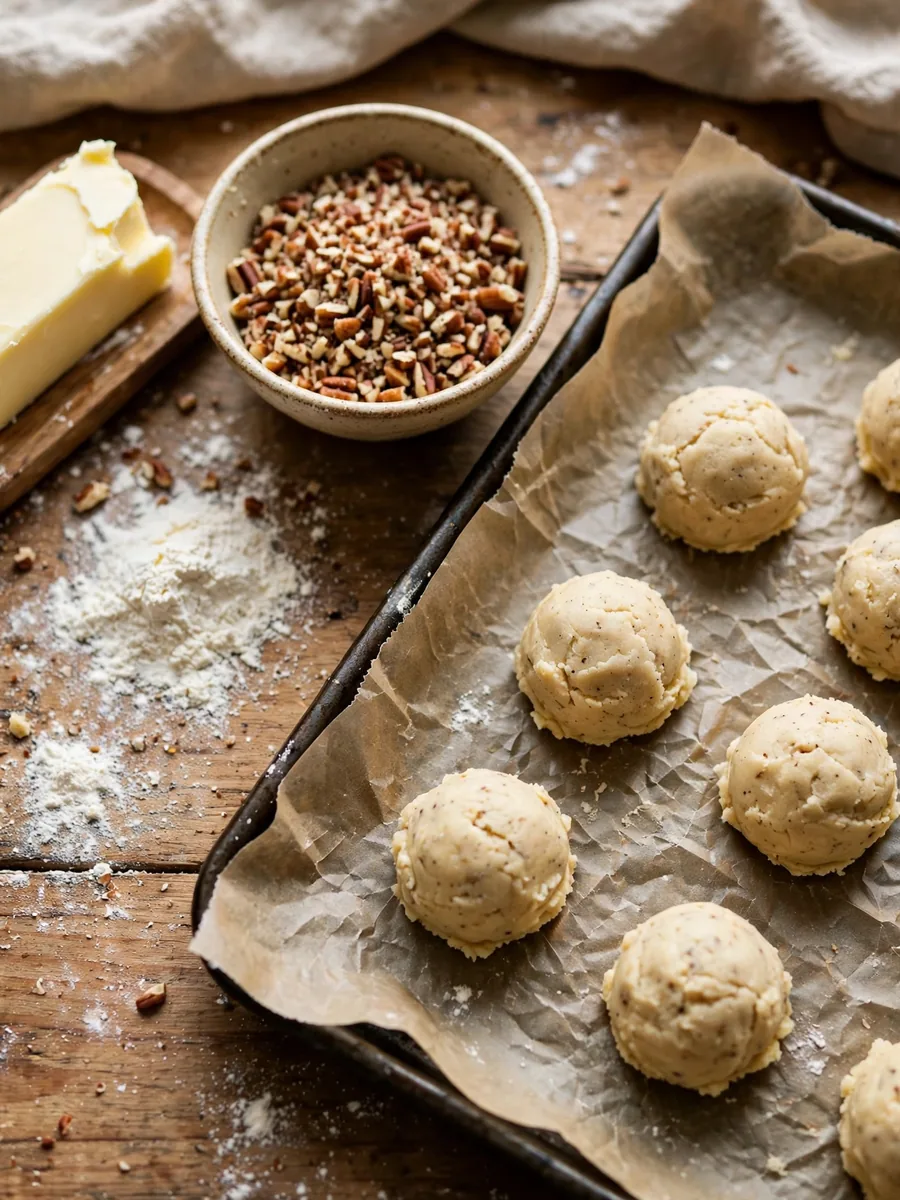
This recipe needs five core ingredients and one bowl, with toasted pecans as the only extra step. The chill is short, the bake is short, and the method is forgiving once you know the dough will look dry before it comes together.
The cookies keep well, freeze well, and taste better the next day, after the flavors have time to meld. They suit a holiday tray, a cookie swap, or a small batch for coffee, and the double coat gives them a finished look with no icing.
Snowball cookie ingredients
With so few ingredients, each one has a clear job. Butter gives flavor and tenderness, powdered sugar sweetens the dough and coats the outside, flour gives structure, vanilla adds flavor, and salt balances the sweet.
The five core ingredients, and what each one does
Use unsalted butter, softened to room temperature but still slightly firm, not glossy or melted. Butter that is too soft makes cookies that spread and taste greasy and dense.
Use confectioners sugar in the dough, not granulated sugar, since granulated sugar makes the cookies spread and lose their round shape. Spoon the flour into the cup and level it, since scooped flour packs in too much and dries the dough.
Pecans vs walnuts vs almonds
Pecans are the most common choice in American Southern and Mexican wedding cookie versions, and they carry this recipe. Walnuts are the traditional nut in many Russian tea cake recipes, and almonds are the mildest and sweetest swap.
| Nut | Flavor | Best for | Notes |
|---|---|---|---|
| Pecans | Rich, buttery | This recipe, Southern style | Toast 8 to 10 minutes at 300F |
| Walnuts | Slight tannic edge | Russian tea cakes | Toast in a pan 4 to 6 minutes |
| Almonds | Mild, sweet | Italian and Spanish polvorones | Mildest and sweetest swap |
| Hazelnuts | Assertive, nutty | A stronger nut flavor | Most assertive of the swaps |
| Pistachios | Rich, green | Color and flavor change | Chop finely, toast if desired |
Butter vs shortening
Butter leads here, because the top recipes use it and it gives the rich flavor and tender crumb. Shortening is a swap, not an equal alternative, and it changes the texture in a clear way.
| Fat | Flavor | Texture | Best use |
|---|---|---|---|
| Unsalted butter | Rich, buttery | Tender, slightly denser | This recipe |
| Vegetable shortening | Plainer, less rich | More crumbly, less spread | Cranberry orange version, firmer bite |
| Butter flavored shortening | Buttery note | Firm, shelf stable longer | Southern pecan butterballs |
| Vegan butter sticks | Milder, some flavor loss | Delightful texture | Dairy-free and vegan version |
How to make snowball cookies
This recipe follows the amounts in the Sally’s Baking Addiction snowball cookies recipe, which sits in the middle of the range used by the top recipes. The work splits into four parts: toast the nuts, make the dough, chill and bake, then coat twice.
Step 1: Toast and chop the nuts
Spread the pecans on a lined baking sheet and toast them 8 to 10 minutes at 300F, until you smell them. Let them cool completely, then chop them very finely, to coarse sand with a few small pieces and no piece larger than a pea.
Do not chop warm nuts, since they turn oily and paste-like in a food processor. Chop too coarsely and the cookies crumble, because large pieces break up the dough, and chop too finely and the texture is lost.
Step 2: Make the dough
Beat the butter for 1 minute until smooth and creamy, then add the 3/4 cup confectioners sugar and beat until combined and creamy. Beat in the vanilla, then add the flour and salt on low speed.
The dough will look dry, and you may think the flour will not combine. Turn the mixer up, and the dough will come together, then beat in the pecans. Mix only until just combined after the flour goes in, since overmixing develops gluten and makes tough cookies.
Step 3: Chill, roll, and bake
Cover the dough and chill at least 30 minutes and up to 3 days. If you chill it for 3 hours or more, let it sit at room temperature for at least 30 minutes before rolling, since it will be very stiff.
Preheat the oven to 350F, line 2 baking sheets with parchment, and scoop 1 tablespoon of dough per cookie. Roll each scoop into a ball, place them at least 2 inches apart, and bake about 15 minutes, until the bottom edges are golden and the tops are just barely browned.
Sources disagree on bake time and temperature, from 325F for 17 to 19 minutes to 400F for 8 to 10 minutes. This recipe uses 350F, the most common temperature, and the visual cue matters more than the clock: golden bottoms and pale tops.
Step 4: Roll twice in powdered sugar
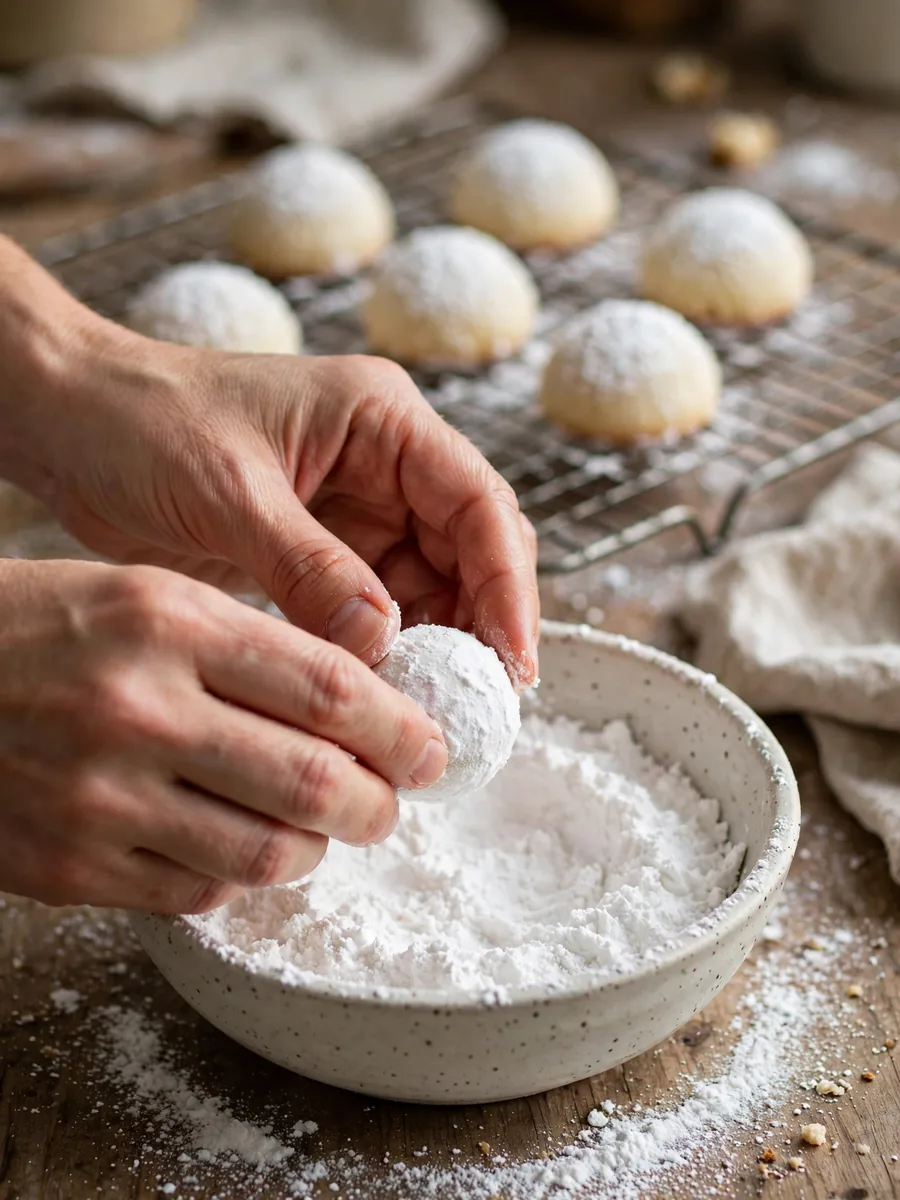
Cool the cookies 5 minutes on the baking sheet, then roll them gently in confectioners sugar and set them on wire racks to cool completely. The first layer melts a bit and gets sticky, which is normal and helps the second layer grip.
Once the cookies are completely cold, roll them again in confectioners sugar. That second roll is when the sugar really sticks and gives the thick, snowy coat.
How to get the powdery coat to stick
The coat sticks when the timing is right, and the timing is simple: first roll warm, second roll cold. Every top recipe uses the double coat, and the two rolls do different jobs.
First roll warm, second roll cold
Roll about 5 minutes out of the oven, just when the cookies can be handled. The sugar partly dissolves and sets into a thin glaze, and it looks patchy and damp at that stage, which is correct. Roll again once the cookies are completely cold for the thick coat.
What to do if the sugar melts or falls off
If the sugar melts into a gray paste, the cookies were rolled straight out of the oven, so wait the full 5 minutes next time. If the sugar falls off, the cookies were rolled when already cold with no first coat, so do the first roll warm and the second cold.
As a last resort, lightly brush the cookies with melted butter before rolling. Give the cookies a fresh dusting just before serving if the coat looks thin after storage.
Snowball cookie variations
The dough takes flavor changes well, and most swaps keep the same method and bake time. Change one thing at a time, so you can tell what worked.
Chocolate snowball cookies
Add 1 to 2 tablespoons unsweetened cocoa powder to the dough, or add mini chocolate chips. A full chocolate version uses cocoa shortbread balls, no eggs, bakes 12 to 15 minutes at 350F, and rolls twice in powdered sugar.
Peppermint snowball cookies
Add 1 teaspoon peppermint extract, or 1/2 teaspoon peppermint extract with 3/4 cup chopped peppermint bark and 1/4 cup mini chocolate chips. Crushed peppermint candy canes also work in the coating sugar.
Orange and citrus snowball cookies
Add the zest of one lemon or orange to the dough, or use orange zest with orange extract instead of vanilla. A chocolate orange version adds chopped chocolate orange segments, and a lemon version uses lemon zest and lemon oil.
Gluten-free snowball cookies
Use a 1 to 1 gluten-free flour blend in place of the all-purpose flour. Cup 4 Cup and Bob’s Red Mill 1 to 1 are the blends named most often, and a chocolate version also works with 1 teaspoon xanthan gum for binding.
Dairy-free and vegan snowball cookies
Use vegan butter or plant-based butter sticks 1 to 1 in place of the butter. Earth Balance butter sticks are the named option, and solid coconut oil, not melted, is another dairy-free choice. Expect some flavor loss, but the texture stays delightful.
Small batch and scaling for a crowd
The recipe makes about 36 cookies at 1 tablespoon per cookie, and the same oven temperature and bake time work at other sizes. Judge by the golden bottoms and pale tops, not by the clock alone.
How to make a small batch
Halve every amount in the recipe, including the coating sugar, for about 18 cookies. Keep the oven at 350F and the bake at about 15 minutes, since the cookie size stays the same and only the count changes.
How to double the recipe for a cookie swap or holiday tray
Double every amount for about 72 cookies, and mix in two batches if your bowl is small. Bake one tray at a time, or rotate the trays halfway, and keep the dough chilled while the first trays bake.
Make-ahead and freezing
Snowball cookies suit making ahead, and the dough freezes better than the baked cookies. Plan the freezing stage around the sugar coat, since the coat does not freeze as well as the cookie.
How to freeze the dough
Roll the dough into balls and freeze them up to 3 months. Bake from frozen with 1 to 2 extra minutes and no need to thaw, which is the advice most sources give. One source says to thaw 1 to 2 hours first, but the majority bake from frozen.
How to freeze baked cookies
Freeze baked cookies up to 3 months, and up to 6 months in a tightly sealed rigid container, not a freezer bag. Freeze them after the first warm sugar roll, thaw them in the closed container so condensation does not soak the sugar, then do the second roll.
Another way is to freeze fully baked cookies without any powdered sugar and coat them twice after thawing. Either way, roll again in powdered sugar after thawing to restore an even look.
How far ahead you can bake them
Bake them up to 1 week ahead for room temperature storage, or up to 3 months ahead if you freeze them. The flavor improves the next day and for several days after, so baking a day early is a good plan, not a compromise.
How to store snowball cookies
Store the cookies in an airtight container, layered between parchment or waxed paper, at room temperature. The fridge is an option, but most sources do not refrigerate them, and one source says refrigeration is not needed.
| Where | How | How long |
|---|---|---|
| Room temperature | Airtight container, layered with parchment | 5 days, up to 1 week |
| Pantry | Airtight container | 4 days |
| Fridge | Airtight container | Up to 2 weeks |
| Freezer, baked | Rigid container, not a bag | Up to 3 months, up to 6 months |
| Freezer, dough balls | Freezer bag or container | Up to 3 months |
Troubleshooting: why your snowball cookies went wrong
Most problems show up before the cookies cool, and most have a clear cause. The table below covers the common ones, with the fix for each.
| Problem | Likely cause | Fix |
|---|---|---|
| Spreading or going flat | Butter too soft, dough not chilled, oven too cool | Chill dough 20 to 30 minutes, use butter that is soft but still slightly firm |
| Dry cookies | Overbaking, too much flour | Bake until bottoms are golden and tops stay pale, spoon and level flour |
| Crumbly or falling apart | Dough too dry, nuts chopped too coarsely, moved before cooling | Mix longer until dough holds when pressed, chop nuts finer, cool before moving |
| Sugar will not stick | Rolled stone cold with no first coat, or straight from the oven | First roll warm at about 5 minutes, second roll cold, brush with melted butter as a last resort |
| Dough will not come together | Normal for this dough, it looks dry and shaggy first | Turn the mixer up and keep going, or work it with hands, knead in 1 teaspoon milk if it still cracks |
| Tough cookies | Overmixing after adding flour | Mix until just combined once the flour goes in |
| Tops browning | Baked too long or too hot | Judge by the base, not the top, tops should stay pale and matte |
What to serve with snowball cookies
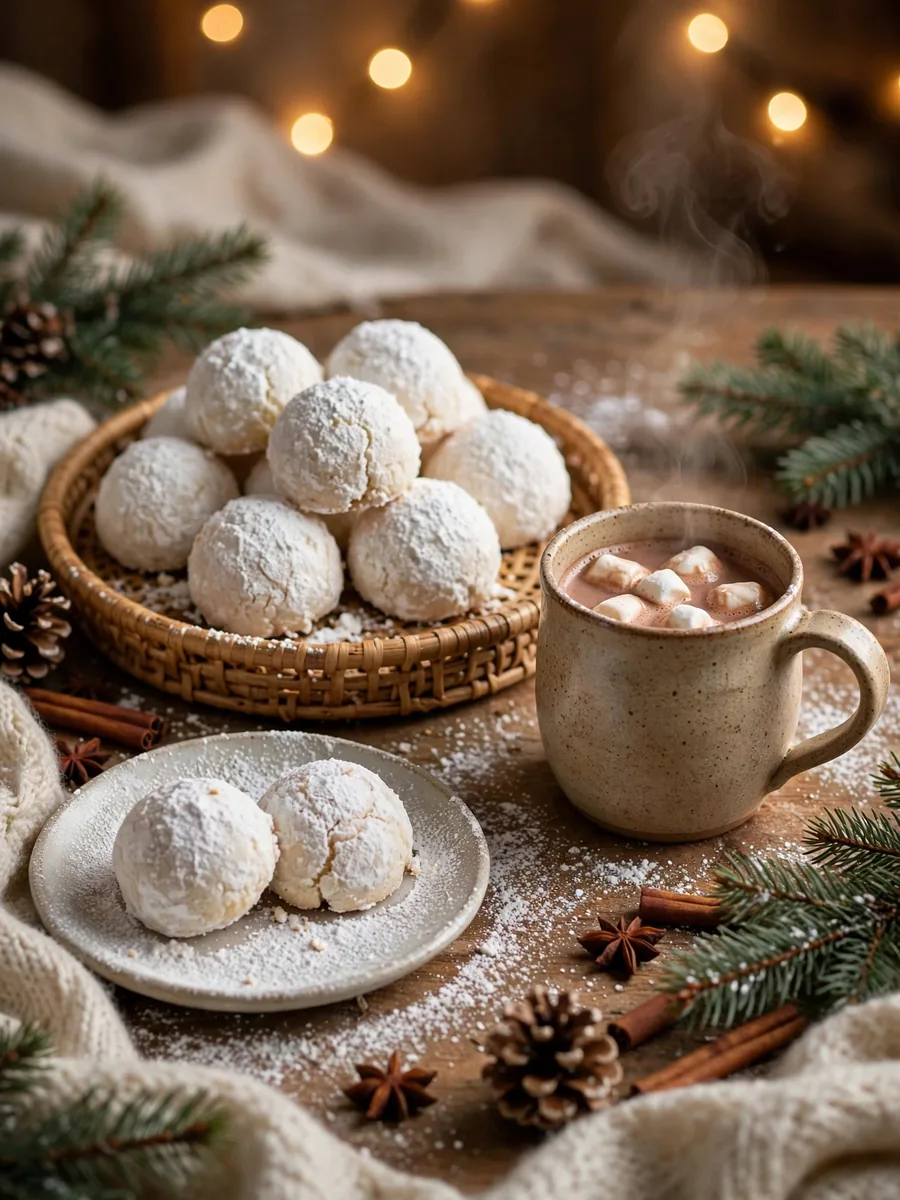
Serve them on a holiday cookie tray with other small cookies, since their white coat stands out next to darker cookies. They also work as a small sweet with coffee, tea, or cocoa, and they travel well to a cookie swap.
Holiday cookie trays, coffee, tea, and cocoa
Pair them with hot coffee, black tea, or cocoa, which balance the sweet sugar coat. On a tray, keep them in their own group, since the powdered sugar can dust the cookies next to them.
More cookies to try
If you want another cookie with a fun twist, try our viral cookies, a croissant stuffed with chocolate chip cookie dough. For a shaped cookie with citrus flavor, our fun cookie recipes use fresh orange zest and a fish cutter.
For holiday baking beyond cookies, a doberge cake is a layered New Orleans cake with custard filling and ganache, a bigger project for the same table.
Snowball cookies recipe
This is the classic version, with toasted pecans and a double sugar coat. Chill the dough at least 30 minutes, bake at 350F, and roll twice, once warm and once cold.
Prep time: 15 minutes, plus 30 minutes chilling
Cook time: 15 minutes
Serves: 36 cookies
Ingredients
- 1 cup (226 g) unsalted butter, softened to room temperature
- 3/4 cup (90 g) confectioners sugar, for the dough
- 2 teaspoons pure vanilla extract
- 2 and 1/4 cups (281 g) all-purpose flour, spooned and leveled
- 1/8 teaspoon salt
- 3/4 cup (100 g) finely chopped toasted pecans
- 1 and 1/4 cups (150 g) confectioners sugar, for coating
Steps
- Toast the pecans 8 to 10 minutes at 300F, cool completely, then chop very finely.
- Beat the butter 1 minute until smooth and creamy, add 3/4 cup confectioners sugar and beat until combined and creamy, then beat in the vanilla.
- Add the flour and salt on low speed, the dough will look dry, then turn the mixer up until it comes together, then beat in the pecans.
- Cover and chill at least 30 minutes and up to 3 days.
- Preheat the oven to 350F (177C), line 2 baking sheets with parchment.
- Scoop 1 tablespoon (20 g) dough per cookie, roll into balls, place at least 2 inches apart.
- Bake about 15 minutes, until golden brown on the bottom edges and just barely browned on top.
- Cool 5 minutes on the baking sheet, roll gently in confectioners sugar, place on wire racks to cool completely, then roll again in confectioners sugar.
One cookie works out to about 118 calories, counted from USDA FoodData Central values for the butter, sugar, flour, and pecans in this recipe. The full batch comes to about 4263 calories for 36 cookies, and the figure is an estimate, not a lab result.
Frequently asked questions
Why are my snowball cookies dry?
Overbaking is the most common reason, and too much flour is the other main cause, especially flour scooped straight from the bag instead of spooned and leveled. Leaving cookies uncovered too long also dries them. Bake until the bottoms are golden and the tops stay pale, and spoon and level the flour.
Why did my snowball cookies go flat or spread?
Butter that is too soft or too warm, dough that was not chilled, an oven temperature that is too low, overmixing, or granulated sugar in the dough instead of confectioners sugar. Chill the dough 20 to 30 minutes, or chill the shaped balls on the tray, and use butter that is soft but still slightly firm.
How do I make powdered sugar stick to snowball cookies?
Roll them twice. Roll the first time about 5 minutes out of the oven, just when the cookies can be handled, so the sugar partly dissolves and sets into a thin glaze. Roll again once the cookies are completely cold for the thick coat. Roll straight from the oven and the sugar vanishes, and roll stone cold with no first coat and nothing sticks.
Can I freeze snowball cookies, and how long do they last?
Yes, both the dough and the baked cookies freeze well. Freeze unbaked dough balls up to 3 months and bake from frozen with 1 to 2 extra minutes. Freeze baked cookies up to 3 months, or up to 6 months in a tightly sealed rigid container, not a freezer bag. Thaw in the closed container, then roll again in powdered sugar.