
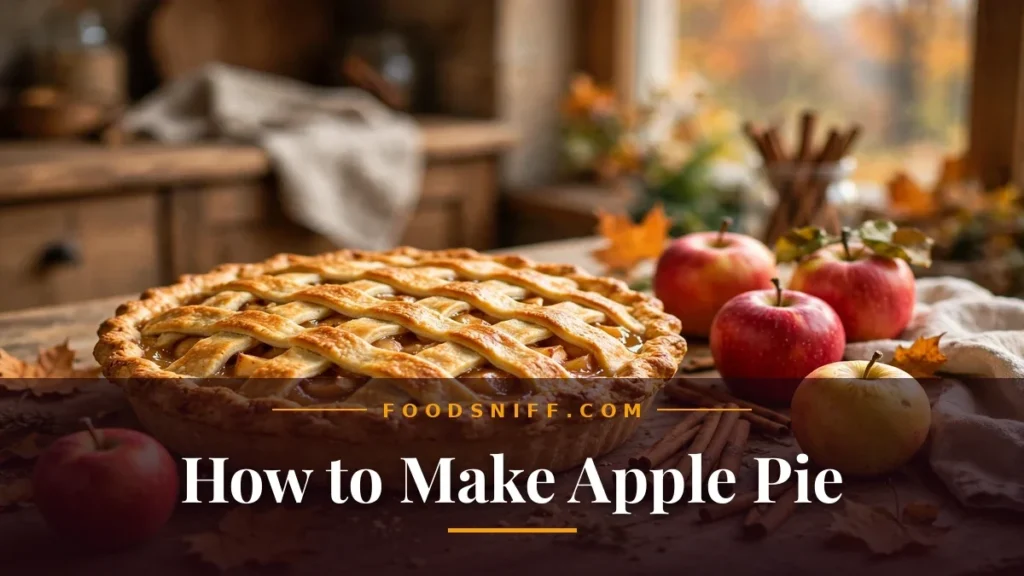
Apple pie is fresh apples tossed with sugar, cinnamon, and lemon juice, piled into a homemade double crust, and baked until the filling bubbles and the crust turns deep golden. It takes about 45 minutes of hands-on work, an hour in the oven, and 3 hours to cool before slicing.
This is the classic version: fresh apples, a homemade all-butter crust, and a filling that cooks in the oven, not on the stove. No canned filling, no shortcuts in the crust, and nothing you need to buy twice.
The method below is the consensus of the best recipes, with the disagreements settled in the open. Two apples beat one, a two-stage bake beats a single temperature, and the cooling time is not optional. Get those three right and the rest is forgiving.
Why this apple pie works
Three choices carry the whole pie. First, the apples are a tart and sweet blend, so the filling has flavor instead of just sweetness. Second, the crust is all butter, kept cold at every step, so it flakes instead of going tough. Third, the bake starts hot and finishes cooler, so the bottom crisps while the apples soften.
The filling is raw when it goes in, which keeps the apple slices intact and the prep short. A short rest after tossing lets the apples release some juice, and draining half of it keeps the filling saucy instead of soupy.
The best apples for apple pie
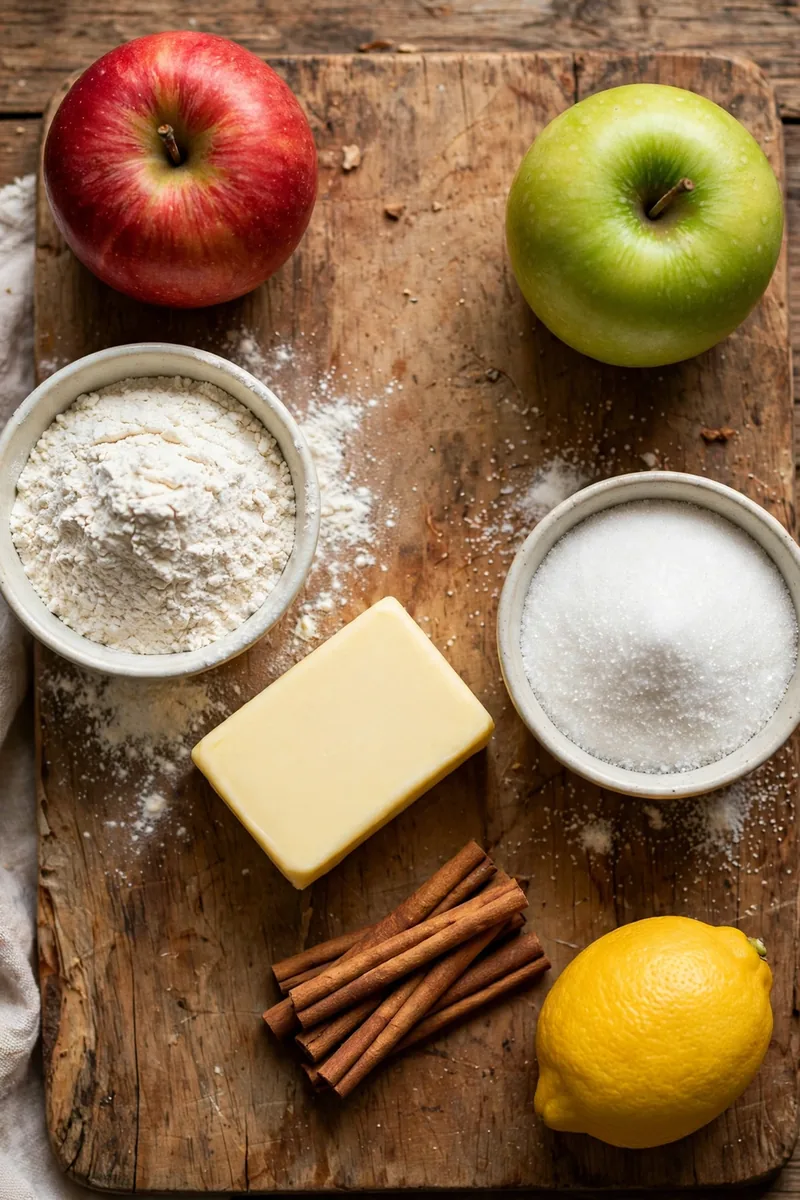
Mix two or three varieties. One tart apple gives the filling its backbone, and one sweet apple gives it roundness. A single variety pie can work, but a blend tastes better and holds up better in the oven.
Granny Smith is the gold standard for pie: tart, firm, and it holds its shape through a long bake. Honeycrisp is the best sweet partner, crisp and sweet-tart. Braeburn is the best single variety, since it softens fully, keeps its shape, and releases little juice.
Apple variety comparison
| Variety | Flavor | Baked texture | Best use |
|---|---|---|---|
| Granny Smith | Tart | Firm, holds shape | Blend anchor, half the pie |
| Honeycrisp | Sweet-tart | Crisp, holds slices | Blend partner, or alone |
| Braeburn | Sweet-tart, deep | Softens fully, little juice | Best single variety |
| Pink Lady | Sweet-tart | Firm, complex | Blend partner |
| Jonagold | Sweet | Tender, holds shape | Blend partner |
| Golden Delicious | Sweet | Soft, can turn mushy | Small share of a blend only |
| McIntosh | Tart-sweet | Breaks down soft | Small share only, disputed |
| Red Delicious | Mild, sweet | Grainy, flavorless baked | Avoid for pie |
How many apples you need
A standard 9-inch pie needs 2.5 to 3 pounds of apples, about 6 to 8 medium ones, which slice into about 10 cups. Buy a little extra, since peeling and coring loses weight, and a short apple makes a flat pie.
Slice the apples a quarter inch thick and keep them even. Thin slices cook through before the crust burns, and even slices mean no crunchy pieces next to mushy ones. Toss them with lemon juice right after slicing so they do not brown.
Apple pie ingredients
The list is short, and every item earns its place. The crust needs flour, butter, sugar, salt, and ice water. The filling needs apples, sugar, flour, lemon juice, and spices. The finish needs an egg, milk, and coarse sugar.
For the crust
All-butter crust tastes better than a butter and shortening blend, and it flakes just as well when the butter stays cold. Cut the butter into the flour until pea-sized pieces remain, since those chunks melt into steam pockets and make the layers.
Use cold unsalted butter, ice water, and a cold bowl if your kitchen is warm. Chill the dough at least 1 hour, and up to 3 days in the fridge. Warm dough shrinks in the oven and bakes tough.
For the filling
Use 4 Granny Smith and 4 Honeycrisp apples, or any tart and sweet blend you like. The sugar is three quarters of a cup granulated plus a quarter cup packed brown sugar, which adds a little caramel note without darkening the filling.
The thickener is a quarter cup of all-purpose flour, which gives a traditional, slightly cloudy set. Cinnamon, nutmeg, and allspice season it, lemon juice brightens it, and two tablespoons of cold butter dotted over the filling melt into richness.
For the finish
Brush the top crust with one beaten egg mixed with a tablespoon of milk, then sprinkle coarse sugar over it. The egg wash browns the crust and the sugar adds crunch. Skip the wash and the top stays pale, even when the pie is done.
How to make apple pie, step by step
The work splits into three parts: crust, filling, and bake. Make the crust first, since it needs to chill, then the filling, then the assembly. The oven preheats while you roll.
Make the pie crust
Whisk the flour, sugar, and salt in a large bowl. Cut in the cold butter with a pastry cutter or your fingertips until pea-sized pieces remain, then add ice water one tablespoon at a time until the dough just comes together.
Divide the dough into two discs, one a little larger for the bottom crust, wrap them in plastic, and chill at least 1 hour. Do not overwork the dough, since overworked dough bakes tough instead of flaky.
Prepare the apple filling
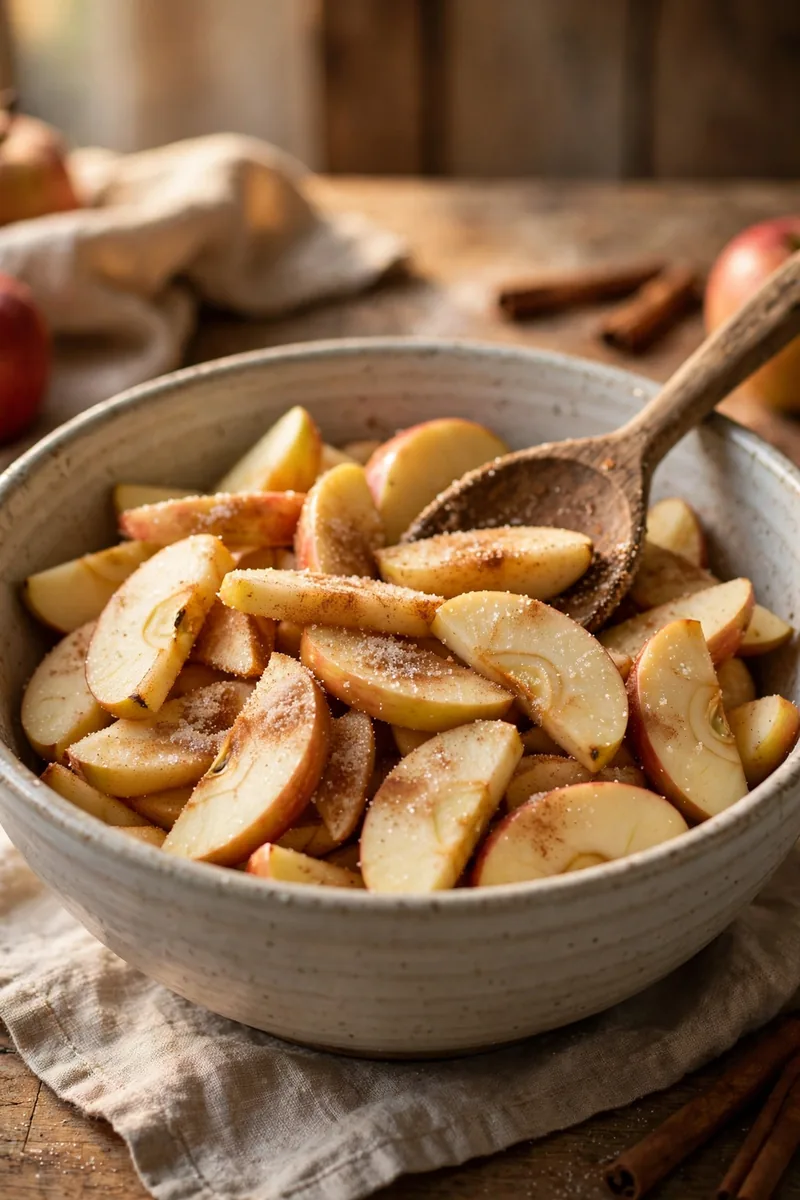
Peel, core, and slice the apples a quarter inch thick. Toss them with the sugars, flour, lemon juice, cinnamon, nutmeg, and allspice, then let them rest 15 to 20 minutes. Drain about half the liquid that collects, since that liquid is what makes a filling runny.
Raw filling keeps the slices intact and the prep short. Pre-cooking the apples on the stove for 5 to 8 minutes shrinks them first, which stops the gap under the top crust, but it adds a step and can turn the apples mushy if it goes too long.
Roll out the bottom crust
Roll the larger disc on a floured surface into a 12-inch circle, turning it a quarter turn after each roll so it stays even. Lift it into a 9-inch metal pie dish, letting the edges hang over the rim, and chill it 15 minutes while you finish the filling.
Metal conducts heat better than ceramic, so the bottom crust crisps instead of steaming. A glass dish works too, and it lets you see whether the bottom is done, but it bakes a little slower, so add 5 to 10 minutes.
Add the filling
Mound the apples into the crust, a little higher in the center, and dot the top with the cold butter pieces. The mound looks too tall, but the apples shrink as they cook, and a flat filling makes a flat pie.
Pour in only the juice that clings to the apples, not the drained liquid. Too much liquid in the dish is the fastest way to a soggy bottom and a runny filling.
Add the top crust
Roll the second disc into an 11-inch circle. For a full double crust, lay it over the filling, trim the edges to a half inch, fold the top edge under the bottom edge, and crimp. Cut 4 to 5 slits for steam.
For a lattice, cut the dough into three quarter inch strips, weave them over and under across the pie, and trim and crimp the same way. A lattice shows the filling bubbling, which is the best doneness cue you have, and it bakes a few minutes faster than a full top.
A crumb topping, made from flour, butter, sugar, and oats, is the third option, and it suits a pie that will be served warm with ice cream.
Bake the pie
Brush the top with egg wash, sprinkle coarse sugar, and set the pie on a baking sheet on the lowest rack. Bake at 425 degrees for 20 minutes, then lower the oven to 375 and bake 40 to 50 minutes more, until the crust is deep golden and the filling bubbles through the vents.
If the edges brown too fast, cover them with a foil ring or a pie shield after the first 25 minutes. Total bake time runs 60 to 70 minutes, and underbaking is the most common mistake, so trust the bubbling more than the clock.
Cool before slicing
Cool the pie on a wire rack for at least 3 hours before slicing. The filling is still liquid when it comes out of the oven, and it needs time to set. Cut it warm and the filling runs across the plate.
Prep time: 45 minutes
Cook time: 1 hour 10 minutes
Serves: 8
Ingredients
- 2 1/2 cups all-purpose flour
- 1 tablespoon granulated sugar
- 1 teaspoon salt
- 1 cup cold unsalted butter, cut into cubes
- 6 to 8 tablespoons ice water
- 10 cups sliced peeled apples, about 8 large (4 Granny Smith, 4 Honeycrisp)
- 3/4 cup granulated sugar
- 1/4 cup packed brown sugar
- 1/4 cup all-purpose flour
- 1 tablespoon lemon juice
- 1 1/2 teaspoons ground cinnamon
- 1/4 teaspoon ground nutmeg
- 1/4 teaspoon ground allspice
- 2 tablespoons cold unsalted butter, cut into pieces
- 1 large egg, beaten with 1 tablespoon milk
- 1 tablespoon coarse sugar
Steps
- Whisk the flour, sugar, and salt. Cut in the butter until pea-sized pieces remain, then add ice water until the dough just comes together.
- Divide into two discs, wrap, and chill at least 1 hour.
- Peel, core, and slice the apples 1/4 inch thick. Toss with the sugars, flour, lemon juice, cinnamon, nutmeg, and allspice. Rest 15 to 20 minutes, then drain about half the liquid.
- Heat the oven to 425 degrees. Roll the larger disc into a 12-inch circle and line a 9-inch metal pie dish.
- Mound the apples into the crust and dot with the butter pieces.
- Roll the second disc into an 11-inch circle, lay it over the filling, trim, crimp, and cut slits for steam. Or weave a lattice top.
- Brush with egg wash, sprinkle coarse sugar, and bake on a sheet on the lowest rack at 425 degrees for 20 minutes.
- Lower the oven to 375 degrees and bake 40 to 50 minutes more, until the crust is deep golden and the filling bubbles.
- Cool on a wire rack for at least 3 hours before slicing.
One slice works out to about 580 calories, counted from USDA FoodData Central values for the flour, butter, sugar, and apples in this recipe. The full pie comes to about 4642 calories for 8 slices, and the figure is an estimate, not a lab result.
Bake time and temperature
Start hot, then finish cooler. The hot start sets the crust and browns the top, and the lower finish cooks the apples through without burning the edges. Every top recipe uses some version of this two-stage bake.
| Method | Start | Finish | Total time |
|---|---|---|---|
| Two-stage, this recipe | 425 degrees, 20 minutes | 375 degrees, 40 to 50 minutes | 60 to 70 minutes |
| Two-stage, hotter start | 400 degrees, 25 minutes | 375 degrees, 35 to 45 minutes | 60 to 70 minutes |
| Single temperature | 375 degrees, lowest rack | 375 degrees | 60 to 70 minutes |
| Hot sheet method | Sheet preheated at 500 degrees | 425 degrees 25 minutes, then 350 degrees 30 to 40 minutes | 55 to 65 minutes |
How to tell when apple pie is done
Look for three signs together: a deep golden brown crust, filling actively bubbling through the vents or lattice, and a skewer that slides through the apples with little resistance. One sign alone is not enough, since a brown top can hide raw apples.
A thermometer reading is disputed between sources. Sally’s Baking Addiction says the filling should read around 200 degrees, while Leite’s Culinaria says 175 degrees is fully baked. The difference is the apple: 175 is enough for soft apples, and 200 suits firm ones like Granny Smith. Use the visual cues first and the thermometer as a check.
How to keep the bottom crust from getting soggy
A soggy bottom has three causes: too much liquid in the filling, a cool oven floor, or not enough time in the oven. Fix all three and the bottom crisps like the top.
Blind baking, when to do it and when to skip it
For a double-crust apple pie, skip the blind bake. The pie bakes for a full hour, which is long enough to cook the bottom crust through, and combining a baked bottom with an unbaked top is tricky. Blind baking suits single-crust pies with short bakes, like custard, not fruit pies.
If your bottom crusts always come out pale, a partial blind bake helps: chill the lined crust 30 minutes, fill it with pie weights or dried beans, and bake at 375 degrees for 20 minutes before adding the filling. An egg white wash after blind baking adds a waterproof film, per Cook’s Illustrated.
Hot baking sheet and lower rack
Preheat a baking sheet on the lowest rack while the oven heats, and set the pie on it. The hot sheet drives heat into the bottom crust from the first minute. Bake on the lowest rack, not the middle, so the bottom gets the most heat.
Use a metal or glass dish, not ceramic, since ceramic bakes unevenly and keeps the bottom pale. If the bottom still looks pale when the top is done, slide the pie to the lowest rack for the last 10 minutes.
Thickener guide
The thickener decides whether the filling slices clean or runs. Flour is the classic choice, cornstarch sets clearer, and tapioca holds up best in the freezer. The table below compares them for a standard 9-inch pie.
| Thickener | Amount per 9-inch pie | Filling look | Freeze stability | Best use |
|---|---|---|---|---|
| All-purpose flour | 1/4 cup | Soft, slightly cloudy | Releases water when thawed | Classic, traditional pies |
| Cornstarch | 2 to 3 tablespoons | Clear, clean slices | Can turn watery when thawed | Best overall for juicy apples |
| Instant tapioca | 2 tablespoons | Clear, glossy | Stays set through freezing | Freezer pies, juicy apples |
| Instant ClearJel | 2 tablespoons | Clear, steady | Stays set through freezing | Make-ahead and frozen pies |
This recipe uses flour, the traditional pick, because the filling is baked and eaten fresh. If you plan to freeze the pie, swap the flour for 2 tablespoons of instant tapioca, which stays set through freezing and thawing.
Troubleshooting
Most apple pie problems are visible before the pie cools, and most have a fix that saves the next pie, even if this one is already baked.
| Problem | Cause | Prevention and fix |
|---|---|---|
| Runny filling | Too much liquid, underbaked, cut too soon | Drain half the resting liquid, bake until bubbling, cool 3 hours |
| Gap under the top crust | Apples shrank during baking | Mound the filling high, or pre-cook apples 5 to 8 minutes |
| Soggy bottom | Cool oven floor, too much liquid | Hot baking sheet, lowest rack, metal dish, full bake time |
| Cracked top crust | Dough dried out, too few vents | Cut 4 to 5 slits, brush with egg wash, keep dough covered |
| Pale crust | Oven too cool, no egg wash | Egg wash and coarse sugar, bake until deep golden |
| Burnt edges | Edges cook faster than the center | Foil ring or pie shield after 25 minutes |
| Tough crust | Overworked dough, too much water | Stop mixing when it just comes together, keep butter cold |
| Shrunken crust | Gluten not relaxed | Chill the lined crust 30 minutes before baking |
How to store, freeze, and reheat apple pie
Fruit pies made with sugar are food-safe at room temperature for up to 2 days, because the sugar and acid in the fruit slow bacterial growth. That guidance comes from Iowa State University Extension, citing USDA storage rules. After 2 days, refrigerate the pie loosely wrapped for 2 more days.
Make-ahead and freezing
| Stage | Storage | How long |
|---|---|---|
| Dough discs | Fridge, wrapped | Up to 3 days |
| Dough discs | Freezer, wrapped | Up to 3 months |
| Unbaked pie | Freezer, wrapped | Up to 3 months, bake from frozen with 20 to 25 extra minutes |
| Baked pie | Room temperature, loosely covered | Up to 2 days |
| Baked pie | Refrigerator, loosely wrapped | 2 more days |
| Baked pie | Freezer, wrapped | Up to 3 months |
Reheating a slice so the crust stays crisp
Warm slices in a 350 degree oven for 10 to 15 minutes. The oven re-crisps the crust, while the microwave softens it. If you must use the microwave, heat in short bursts and eat it right away.
Freeze the assembled pie for 30 minutes before baking if you want an extra flaky crust. The cold dough holds its shape in the hot oven, and the butter melts slower, which makes more layers.
How to serve apple pie
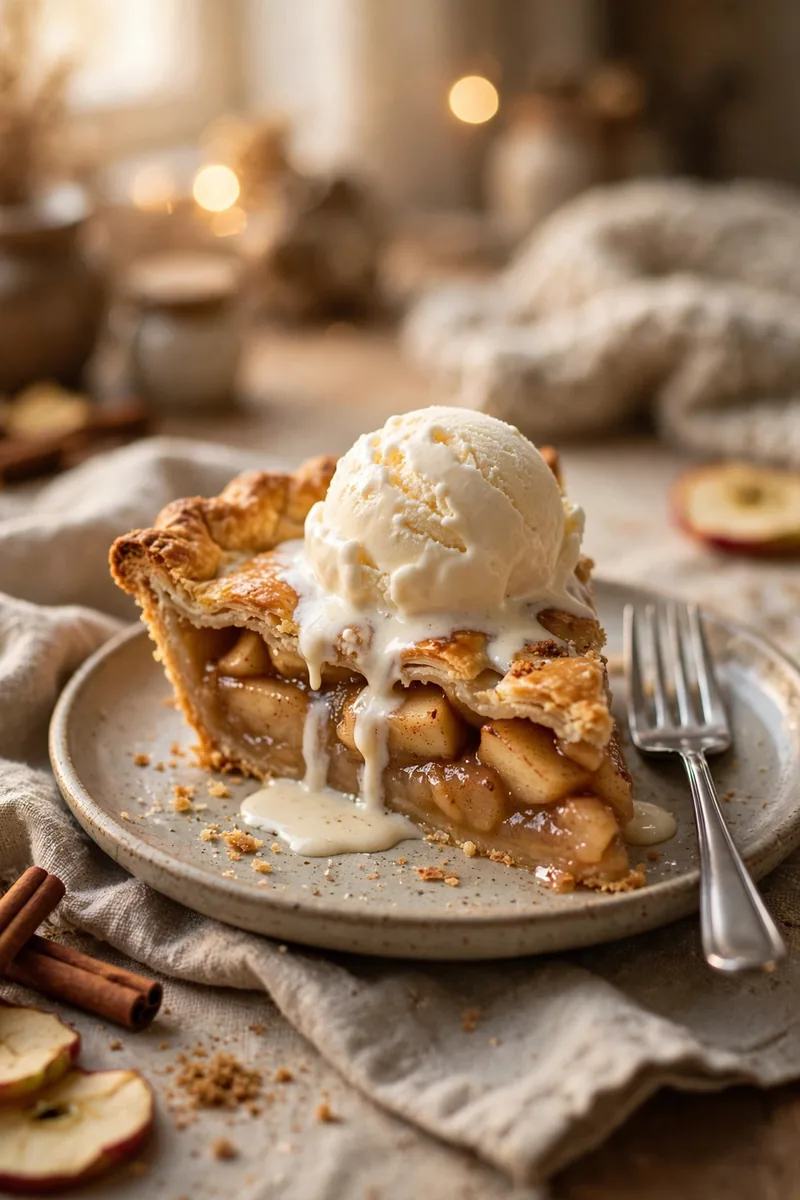
Serve it warm or at room temperature, never hot from the oven, since the filling needs to set. Vanilla ice cream is the classic partner, and it melts into the warm filling. Whipped cream is lighter, and salted caramel drizzle suits a holiday table.
A slice of sharp cheddar on the side is an old New England tradition, and the salt in the cheese plays against the sweet filling. Hot tea or coffee rounds it out. For a Thanksgiving table, our Libby’s pumpkin pie recipe sits next to this one, and our pumpkin dessert recipes cover the rest of the fall desserts.
For a simpler bake the same week, our 2 banana bread recipe uses pantry staples and one bowl. And for a party table, celebration bakes like a gender reveal cake pair with pie as the second dessert. If you want a cake instead of a pie altogether, a doberge cake is the classic layered pick.
Scaling the recipe
A half pie uses a 6-inch dish, half the apples, and about 45 minutes in the oven. A deep dish pie uses 4 pounds of apples in a 9-inch deep dish and needs 10 to 15 extra minutes. Mini pies bake in a muffin pan in about 25 minutes, and a slab pie for a crowd uses a sheet pan, double the apples, and about 50 minutes.
Keep the sugar and thickener in the same ratio to the apples when you scale, and go by bubbling and color rather than time, since a bigger pie needs more minutes to cook through to the center.
Thanksgiving day timeline
Make the dough and the filling the day before, and keep them in the fridge overnight. On Thanksgiving morning, roll, assemble, and bake the pie first, while the oven is free, then cool it on the counter while the turkey roasts.
The pie needs 3 hours to cool, so a morning bake means it is ready for dessert with no oven time left. If the oven is busy all day, bake the pie the day before and warm slices at 350 degrees for 10 to 15 minutes before serving.
Frequently asked questions
How long do you bake an apple pie, and at what temperature?
About 60 to 70 minutes in total. Bake at 425 degrees for 20 minutes, then lower the oven to 375 degrees and bake 40 to 50 minutes more, until the crust is deep golden and the filling bubbles.
Do you have to cook the apples before making apple pie?
No, raw filling works and keeps the apple slices intact. Pre-cook the apples on the stove for 5 to 8 minutes only if you want to shrink them first and stop the gap that forms under the top crust.
How do you keep apple pie from getting a soggy bottom crust?
Drain about half the liquid the apples release while they rest, bake the pie on a preheated baking sheet on the lowest rack, use a metal dish, and bake the full time until the filling bubbles. Underbaking is the most common cause.
How long should apple pie cool before slicing?
At least 3 hours on a wire rack. The filling is still liquid when the pie comes out of the oven, and it needs time to set. Cut it warm and the filling runs across the plate.